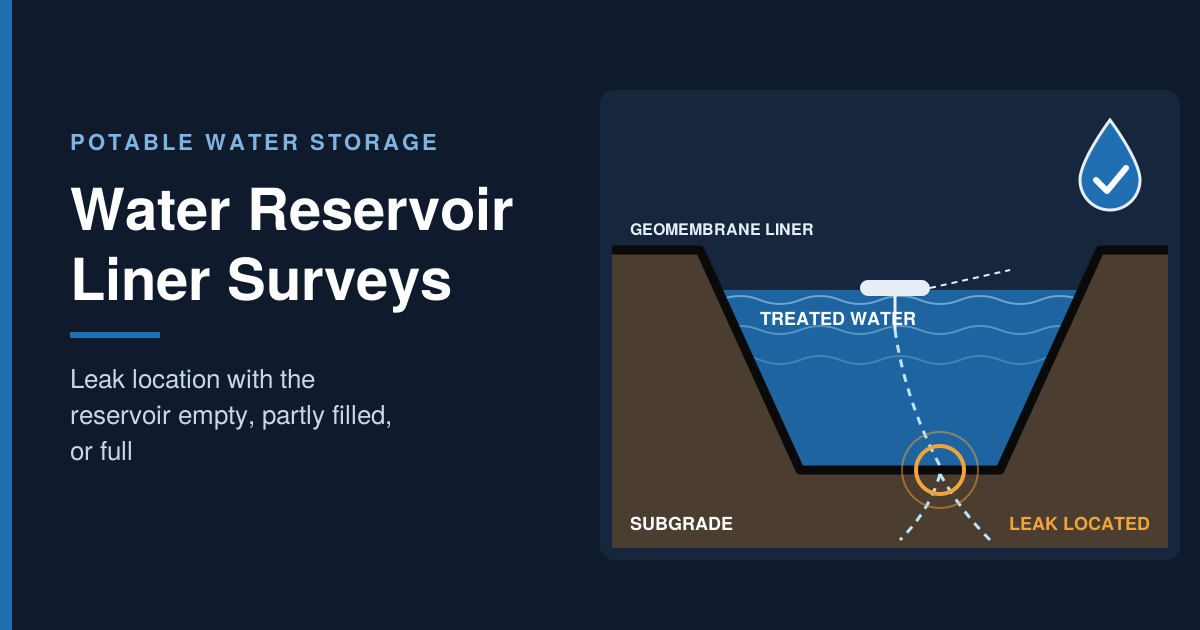
A water reservoir liner survey is an electrical leak location (ELL) test that finds holes in a potable water reservoir’s geomembrane, often without draining the reservoir. Surveys can be run on an empty liner before filling or with water in place, giving utilities documented proof that the barrier is holding treated water.
For drinking water storage, the liner is more than a construction detail. It keeps treated water in, keeps groundwater and soil out, and protects the embankment that supports the reservoir. Material standards confirm a liner is safe to contact drinking water, but only a leak location survey confirms the installed sheet has no holes.
What Is a Water Reservoir Liner Survey?
A water reservoir liner survey is a systematic search of the geomembrane for holes using electrical current. Because a geomembrane is an electrical insulator, current applied in the water above the liner can only reach a grounded electrode outside the liner by passing through a hole, and survey equipment traces that current to the leak.
The methods are standardized. ASTM D6747 guides the selection of electrical leak location techniques, and ASTM D7007 covers electrical methods for locating leaks in geomembranes covered with water or earthen materials. On a reservoir, the survey type depends on whether the liner is exposed, partly filled, or full, and a comparison of LLSI survey types shows how each method fits different site conditions.
| Reservoir Condition | Survey Approach | Typical Use |
|---|---|---|
| Empty, liner exposed | Bare liner survey | New construction before filling, or after a planned drawdown |
| Shallow or partly filled | Water survey, wading mode | Survey personnel wade and systematically scan the submerged liner |
| Deeper water or in service | Water survey, towed array mode | Reservoirs that cannot be taken offline or drawn down |
Which Standards Apply to Potable Water Reservoir Liners?
Potable water reservoir liners fall under a mix of material, installation, disinfection, testing, and federal drinking water requirements. Each one answers a different question, and none of the material standards on their own confirm that an installed liner is free of holes.
| Standard or Rule | What It Covers | What It Does Not Do |
|---|---|---|
| NSF/ANSI/CAN 61 | Health effects of contaminants that materials in contact with drinking water can impart | Does not set performance requirements or verify an installed liner |
| ANSI/AWWA D130 | Minimum requirements for geomembrane lining and floating cover materials, fabrication, installation, and quality assurance | Does not replace a site-specific leak location survey |
| ANSI/AWWA C652 | Disinfection of water storage facilities, including procedures for underwater inspection | Does not address liner leak detection |
| ASTM D6747 and D7007 | Selection and performance of electrical leak location methods | Do not address drinking water health effects |
| 40 CFR 141.714 | Requires systems with uncovered finished water storage to cover the facility or treat its discharge | Does not set liner testing requirements |
What Does NSF/ANSI/CAN 61 Mean for a Reservoir Liner?
NSF/ANSI/CAN 61 means the liner material has been evaluated for chemical contaminants it could impart to drinking water. NSF describes the standard as setting minimum health effects requirements for products that contact drinking water, including protective barrier materials. Certification addresses what the material is made of, not whether the sheet was punctured during installation.
How Does AWWA D130 Apply to Geomembrane Liners?
AWWA D130 applies to geomembrane materials supplied in sheet form for lining, covering, or lining and covering potable water reservoirs. AWWA states that D130 provides minimum requirements for materials, fabrication, installation, and quality assurance, and AWWA Manual M25 complements it with design, installation, and operation guidance. Engineers often pair a D130 reference with a leak location survey requirement in the same specification.
Do Federal Rules Cover Finished Water Reservoirs?
Federal rules do address finished water reservoirs. Under the Long Term 2 Enhanced Surface Water Treatment Rule, 40 CFR 141.714 requires systems using uncovered finished water storage facilities to cover them or treat the discharge to the distribution system. AWWA D130 addresses both geomembrane linings and floating covers, so a reservoir covered to meet the rule can still need its liner verified.
What Do State Drinking Water Programs Require?
State drinking water programs set their own plan review, construction, and inspection requirements for storage facilities, and those requirements vary widely. States with primacy also enforce federal rules such as 40 CFR 141.714 through their own regulations. Before scoping a survey, confirm with the state drinking water program which standards the project specifications must reference and what documentation the program expects at commissioning.
An independent survey report gives the utility a clear record for that review: the survey date, method, area, detection sensitivity, and the location and repair of every leak found. Leak Location Services, Inc. survey reports document the survey area, the leak detection sensitivity setting, and a figure showing where each leak was found.
How Does Electrical Leak Location Work in a Filled Reservoir?
Electrical leak location works in a filled reservoir by using the water itself as the conductive medium. A voltage is applied between an electrode in the reservoir water and a ground electrode outside the liner. Where the geomembrane is intact, it blocks the current; where there is a hole, current flows through it and creates a measurable signal in the water near the leak.
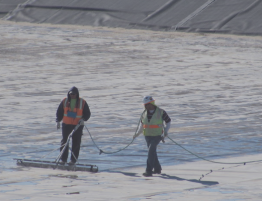
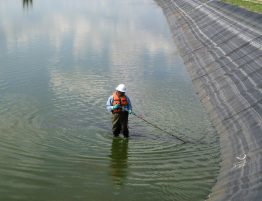
Leak Location Services, Inc. performs water-covered geomembrane surveys in wading and towed modes. In wading mode, survey personnel wade in the water and scan the submerged liner. In towed mode, equipment is pulled across the water surface so deeper reservoirs can be surveyed without draining.
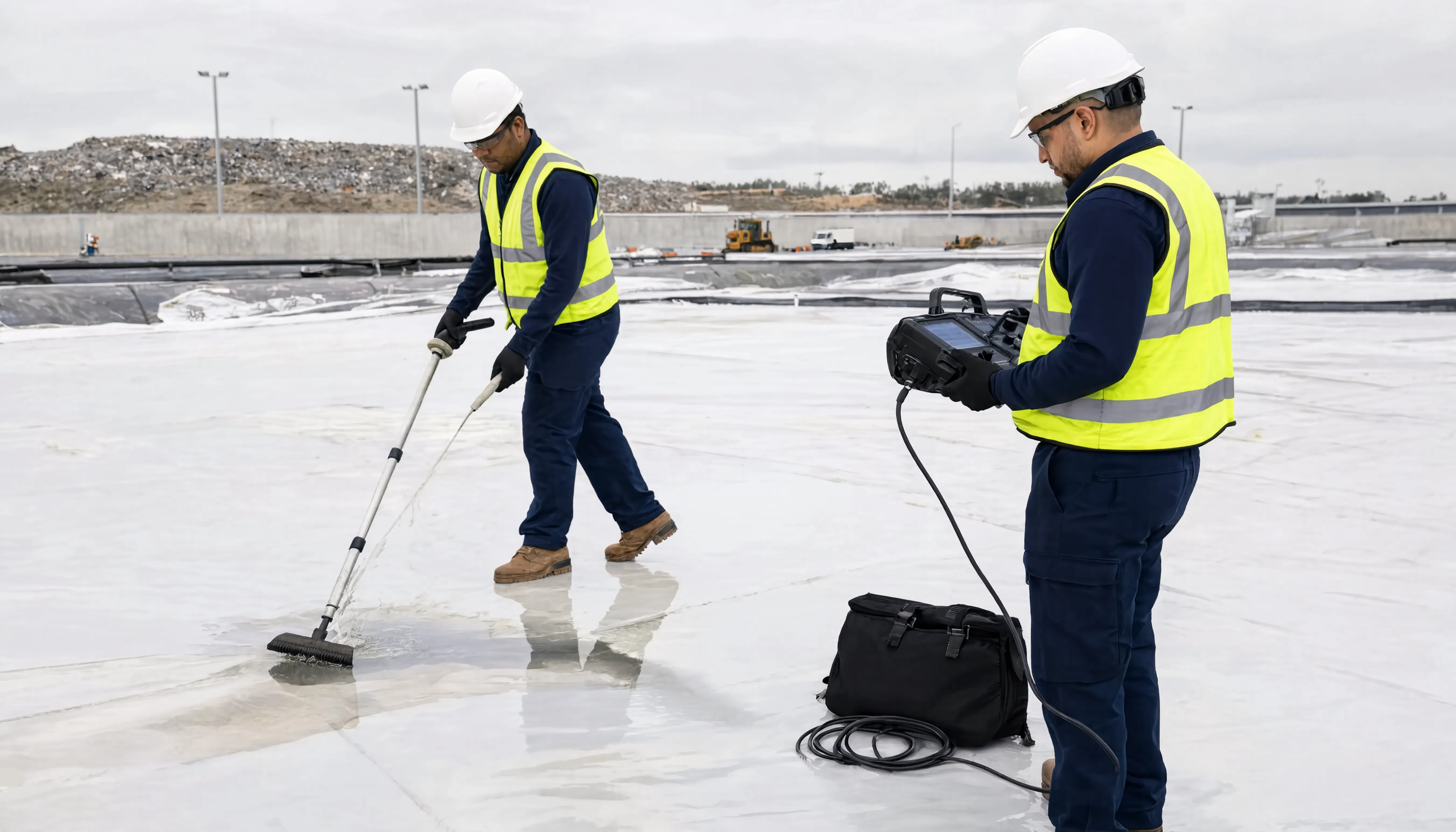
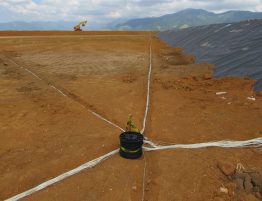
When a reservoir can be emptied, or before a new reservoir is filled, bare liner surveys on the exposed geomembrane locate installation damage while repairs are simple to make.
When Should a Potable Water Reservoir Liner Be Surveyed?
A potable water reservoir liner should be surveyed before it goes into service, after any repair, and whenever unexplained water loss or embankment wetness suggests a leak. Each survey adds to a documented record of the liner’s condition.
- Before first fill: A survey after installation catches seaming defects, punctures, and equipment damage before the reservoir holds treated water.
- After repairs: A follow-up survey of the repaired area confirms each patch holds and that no nearby hole was missed.
- After floor work: Cleaning, sediment removal, or other maintenance on the reservoir floor can damage the liner and warrants a survey.
- When symptoms appear: Unexplained water loss, wet areas on the embankment, or underdrain flow are reasons to schedule a water survey.
- Before cover projects: Verifying the liner before a floating cover is installed or replaced avoids sealing a known problem under a new cover.
What Are the Risks of Undetected Leaks in Drinking Water Reservoirs?
Undetected leaks in drinking water reservoirs waste treated water, saturate embankment soils, and can open a path for outside water to enter. Treated water has already been paid for once, so every gallon lost through a hole is a direct operating cost.
Water escaping into the embankment can soften compacted fill and erode subgrade beneath the liner over time. The same hole can also work in reverse: when groundwater outside the liner stands higher than the water inside, as can happen during a drawdown, outside water can move into the reservoir. Finished water stored at that point has already been treated, so contamination entering storage bypasses the treatment plant.
How Should Survey Crews Protect Treated Water?
Survey crews protect treated water by following the utility’s disinfection and sanitary procedures before any person or piece of equipment contacts the reservoir. AWWA C652 covers disinfection of water storage facilities, including procedures for underwater inspection and cleaning, and notes that minimally intrusive in-service work may require only sampling when rigorous sanitary procedures are followed.
Write those expectations into the survey scope. Specify which AWWA C652 procedures apply, who disinfects equipment, whether post-survey sampling is required, and how the reservoir is returned to service if it was taken offline.
How Leak Location Services, Inc. Surveys Reservoir Liners
Leak Location Services, Inc. (LLSI) is a San Antonio-based firm that has specialized in electrical leak location surveys of geomembranes since 1992. LLSI has surveyed more than half a billion square feet of geomembrane, with water surveys, soil surveys, and bare liner surveys performed under ASTM methods.
For potable water owners and their engineers, LLSI can survey a reservoir empty, partly filled, or full, and works as an independent firm separate from the liner installer. Engineers preparing bid documents can review LLSI qualifications and survey specifications, and project details can be discussed by calling 210.408.1241.
Frequently Asked Questions About Potable Water Reservoir Liner Surveys
Does a potable water reservoir need to be drained for a liner survey?
A potable water reservoir does not need to be drained for a liner survey. Water surveys use the reservoir water as the conductive medium, with wading mode for shallow water and towed mode for deeper water. A bare liner survey is used when the reservoir is empty, such as before first fill or during a planned drawdown.
Which ASTM standard applies to a water-covered liner survey?
ASTM D7007 applies to a water-covered liner survey. It covers electrical methods for locating leaks in geomembranes covered with water or earthen materials. ASTM D6747 is the companion guide for selecting the right electrical leak location technique for the site, including exposed-liner methods used before a reservoir is filled.
Does NSF/ANSI/CAN 61 certification mean a liner has no leaks?
NSF/ANSI/CAN 61 certification does not mean a liner has no leaks. The standard evaluates health effects from chemical contaminants a material could impart to drinking water. It does not test an installed liner for punctures, seam defects, or equipment damage. A leak location survey is the step that verifies the installed geomembrane.
Can a liner survey confirm that repairs are sound?
A liner survey can confirm that repairs are sound. After patches are made, a follow-up survey of the repaired areas checks that each repair holds and that no adjacent hole was masked by a larger leak. Including repair verification in the specification gives the utility a complete record from first survey to final acceptance.
Should the liner installer perform the reservoir survey?
The liner installer should not perform the reservoir survey. An independent leak location firm hired by the utility or its engineer has no stake in how many holes are found or who pays for repairs. That separation makes the survey record more credible to regulators, engineers, and the utility’s own governing board.
To schedule a water reservoir liner survey before first fill, after repairs, or on an in-service reservoir, contact Leak Location Services, Inc. at 210.408.1241.