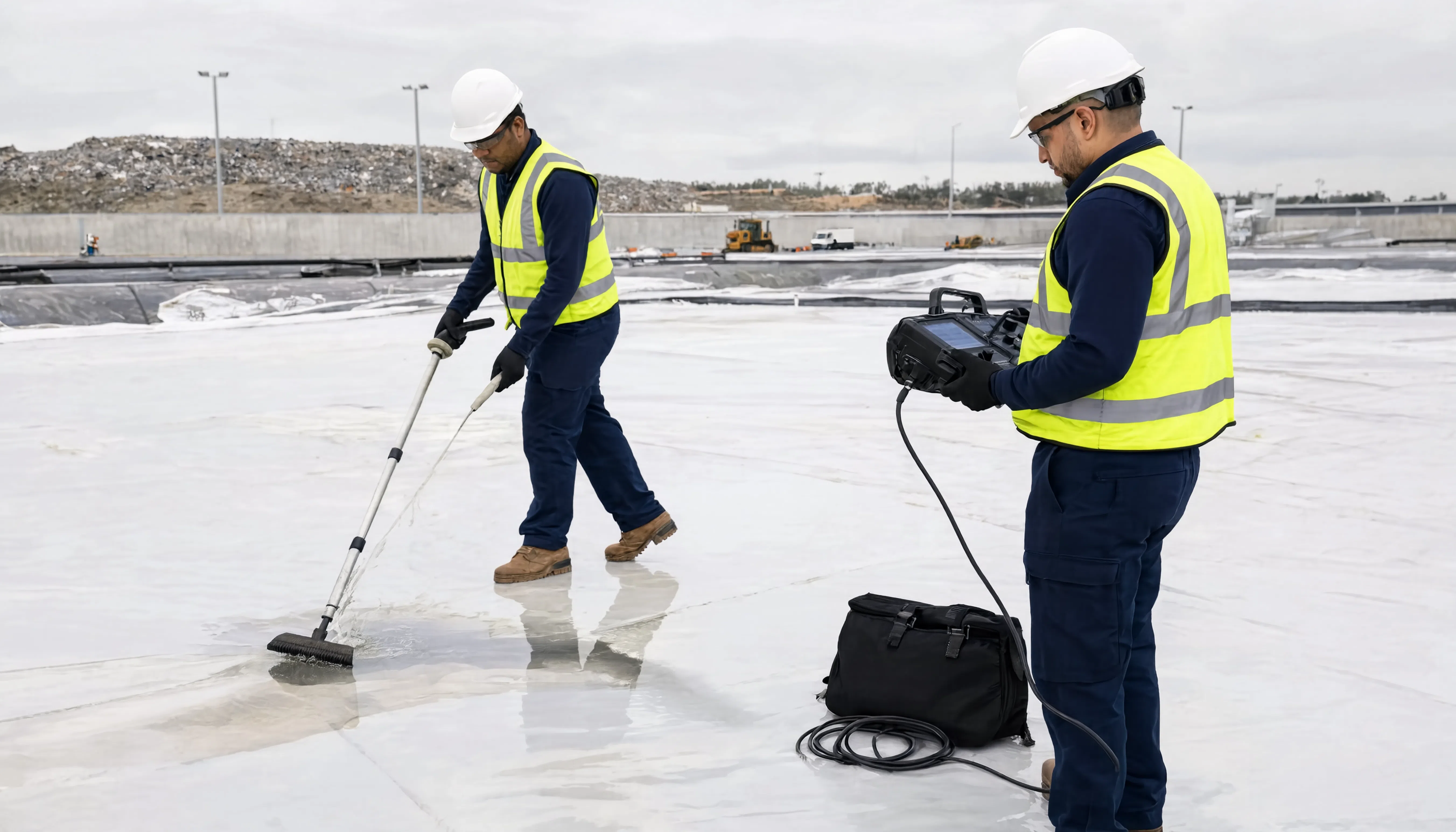
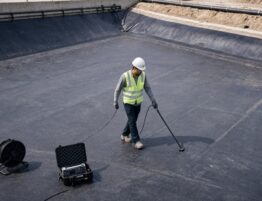
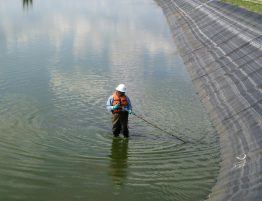
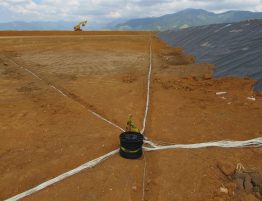
An electrical leak location survey finds holes in a geomembrane by passing electrical current across the liner. An intact geomembrane is an electrical insulator, so current can only flow where there is a hole, puncture, tear, or seam defect. Technicians map where that current flows and mark each leak for repair, whether the liner is exposed, under water, or buried under soil.
This guide explains how the method works, which ASTM standards apply, what happens in the field, and when to specify a survey so the results are useful to your project team and your regulator.
What Is an Electrical Leak Location Survey?
An electrical leak location (ELL) survey is a test of the entire installed geomembrane, not just the seams. It uses the liner’s insulating property to find breaches that visual inspection and seam testing cannot see, including damage that happens after the liner is covered.
ELL works on liners made of polyethylene, polypropylene, PVC, chlorosulfonated polyethylene, bituminous material, and other electrically insulating materials, according to ASTM D7007-24. It is used on landfill cells, ponds, tanks, reservoirs, ore pads, and industrial impoundments.
Traditional quality control still matters. Seam testing checks welds, and visual inspection catches obvious damage. ELL adds a check of the full liner surface. For a side-by-side look at where each approach fits, see our overview of electrical vs. traditional geomembrane leak detection methods.
How Does Electrical Leak Location Work?
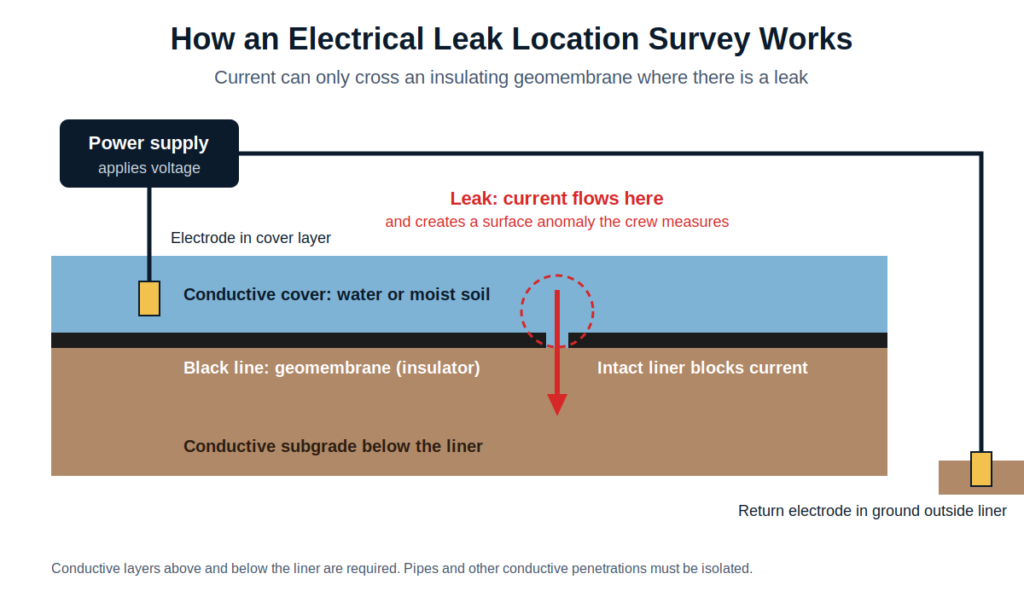
ELL places a voltage across the geomembrane and then looks for places where current passes through it. The only way current can cross an insulating liner is through a leak, so every point of current flow is a candidate defect.
The setup needs three things:
- A conductive layer above the liner. This can be water, moist soil, or drainage material placed over the geomembrane.
- A conductive layer below the liner. This is usually the subgrade, but it can also be a geosynthetic clay liner (GCL) or a conductive layer bonded to the geomembrane itself.
- No other electrical paths. Pipe penetrations, flange bolts, steel drains, and batten strips must be isolated. Otherwise current flows through them and masks real leak signals, as ASTM D6747-21 explains.
One electrode goes into the material above the liner, and a return electrode goes into the ground outside the lined area. When power is applied, an intact liner blocks the circuit. Where a hole exists, current flows through it and creates a concentrated electrical field on the surface above. Survey crews measure the surface voltage in a systematic pattern and pinpoint the source of each anomaly.
Which ELL Method Fits Your Project?
The right method depends on what is on top of the liner when it is tested. Our technicians select the method based on site conditions, but project owners should know the options before writing a specification.
| Method | Liner condition | ASTM practice | Typical use |
|---|---|---|---|
| Water puddle | Exposed (bare) | D7002 | Final check after seaming and standard CQA, before cover placement |
| Spark testing | Exposed, conductive-backed liner | D7240 | Bare liners where water puddle testing is not practical |
| Arc testing | Exposed, non-conductive liner | D7953 | Bare liners where water puddle testing is not practical and no conductive layer is present |
| Water-covered survey | Covered with water | D7007 | Ponds, tanks, and impoundments, including facilities already in service |
| Soil-covered (dipole) survey | Covered with soil or drainage material | D7007 / D8265 | Landfill cells, pads, and covered liners after construction traffic is complete |
Sources: ASTM D7007-24, ASTM D8265.
For water-covered liners, our crews either wade or tow a sensor. The wading mode requires water between 6 and 30 inches deep. Deeper water, or water that is unsafe to wade in, is surveyed with a towed probe. Details are on our water-covered geomembrane survey page.
Which ASTM Standards Govern ELL Surveys?
Several ASTM standards work together. One is a selection guide, and the rest are field practices for specific liner conditions.
- ASTM D6747 (guide): Helps engineers compare electrical leak location options for exposed, water-covered, and soil-covered geomembranes.
- ASTM D7002: The water puddle practice for exposed geomembranes.
- ASTM D7240: Spark testing for exposed geomembranes that have a conductive layer.
- ASTM D7953: Arc testing for exposed geomembranes without a conductive layer.
- ASTM D7007: Practices for geomembranes covered with water or earthen materials, with separate procedures for each.
- ASTM D8265: Practices for mapping leaks in installed geomembranes covered with liquid or earthen materials, or both.
D7007 is performance-based. Instead of mandating specific equipment, it requires the survey team to verify a minimum leak detection distance in the field. That verification is what makes results defensible, because it proves the equipment and site conditions could actually detect a leak of the specified size. Our ASTM D7007 soil survey services page covers this requirement in more detail.
How Is an ELL Survey Performed in the Field?
Most surveys follow the same sequence, whatever the method.
- Prepare and isolate the site. Isolate metal pipes, concrete structures, batten strips, and grounding wires from the cover material so current can only pass through leaks.
- Set up electrodes and power. Place one electrode in the conductive material above the liner and a return electrode in the ground outside the containment.
- Verify detection capability. Test the system’s response to an actual or artificial leak to confirm the survey can detect the target leak size under that day’s conditions.
- Survey systematically. Crews traverse the lined area in a grid pattern and collect electrical measurements across the entire surface.
- Mark and document leaks. Each detected leak is marked on-site for repair and recorded in the final report. Repaired areas can be resurveyed.
Duration depends on liner size, access, and method. Most bare liner surveys finish within one to three days, and experienced crews can cover several acres of exposed liner per day.
Why Do Geomembrane Liners Leak?
ASTM D8265 lists poor subgrade quality, poor quality of the material placed on the liner, accidents, poor workmanship, manufacturing defects, and carelessness as causes of geomembrane leaks. The most significant cause depends on what covers the liner:
- Water-covered liners: Leaks come mostly from construction activity, including pumps and equipment placed on the liner, accidental punctures, and traffic over rocks or debris, per ASTM D7007.
- Soil-covered liners: The biggest cause is machinery damage while the soil or stone cover is being placed.
That second point is why covered surveys matter. Damage from cover placement happens after seam testing and visual inspection are finished, so those methods cannot catch it.
When Should You Specify an ELL Survey?
Specify ELL during design and build the survey windows into the construction schedule. Most projects benefit from two survey points:
- After seaming, before cover: A bare liner survey finds installation defects while the liner is exposed and repairs are simplest.
- After cover placement, before operation: A soil-covered or water-covered survey finds damage caused while the cover was placed.
For facilities already in service, water-covered surveys can locate leaks without draining the pond or impoundment. For long-term monitoring, a permanently installed Electrical Leak Imaging and Monitoring (ELIM) system uses electrodes placed during liner installation.
What Affects ELL Survey Sensitivity?
ELL methods can detect leaks as small as 1 mm, depending on survey type and site conditions. The factors that matter most are:
- Conductive media on both sides. Water, soil, or a GCL must be present above and below the tested liner. Dry, frozen, or coarse subgrades may need moisture conditioning.
- Double-lined systems. Only the uppermost (primary) geomembrane is tested. A conductive geomembrane is generally needed only when surveying the primary slopes of a double-lined system with no conductive material beneath them.
- Electrical isolation. Unisolated penetrations create false signals and reduce sensitivity.
- Cover conditions. Moisture content and thickness of the cover material affect how well signals travel to the surface.
The electrical methods also involve high voltage. ASTM D7007 warns of the potential for electrical shock or electrocution and states that surveys should be attempted only by qualified, experienced personnel.
Why Use an Independent Leak Location Company?
An independent tester has no stake in the manufacture or installation of the liner, so the results carry no conflict of interest. Leak Location Services, Inc. (LLSI) has no ties to manufacturers or installers, and leak location surveys are our only business.
Our founders began developing geoelectric leak location at Southwest Research Institute in 1980, and the first commercial survey was performed in 1985. Our technical staff has more than 92 years of combined commercial leak location experience. We have completed more than 4,378 surveys covering over 720 million square feet of geomembrane, and in 2025 alone we completed 109 surveys. See our qualifications and survey specifications for staff resumes and specification guidance.
“LLSI has consistently proven their experience and technical know-how on even the most demanding projects, especially soil covered surveys.” — Ron Frobel, PE, RK Frobel & Associates
Frequently Asked Questions About Electrical Leak Location
How small a leak can an electrical leak location survey find?
ELL methods can detect leaks as small as 1 mm, depending on the survey type and site conditions. The water puddle method on exposed liners is among the most sensitive options. Covered surveys depend on cover moisture, thickness, and electrical isolation, which is why ASTM D7007 requires field verification of detection capability before and during the survey.
Can ELL be done after the liner is covered?
Yes. ASTM D7007 covers geomembranes under water or earthen materials, and D8265 covers mapping leaks under liquid or earthen cover. Covered surveys are the only way to find damage from cover placement, which is the leading cause of leaks in soil-covered liners.
Do you need a conductive geomembrane for an ELL survey?
Usually not. The method only needs conductive material, such as water, soil, or a GCL, above and below the tested liner. A conductive geomembrane is mainly needed for the primary slopes of a double-lined system where no conductive material sits beneath the primary liner.
What has to be done to prepare a site for ELL?
The most important step is electrical isolation. Metal pipes, concrete sumps, batten strips, and grounding wires must be isolated from the cover soil or water so current only passes through leaks. The survey area also needs conductive material above and below the liner, which may require wetting a dry cover or subgrade.
Can ELL test a pond that is full of brine or chemicals?
Yes. Water-covered surveys can be run on operating ponds, and LLSI routinely tests ponds containing brine and other chemicals. Depending on depth and water conditions, the crew either wades or uses a towed sensor, so the facility does not have to be drained.
Plan Your Electrical Leak Location Survey
Specifying ELL early, at both the bare liner and covered stages, is the most direct way to find and repair leaks before a facility goes into service. LLSI can help you choose the right method, write specification language, and schedule surveys around construction milestones. We disclose costs up front, with no surprise add-ons.
Call 210.408.1241 or request a leak location survey estimate to discuss your project.