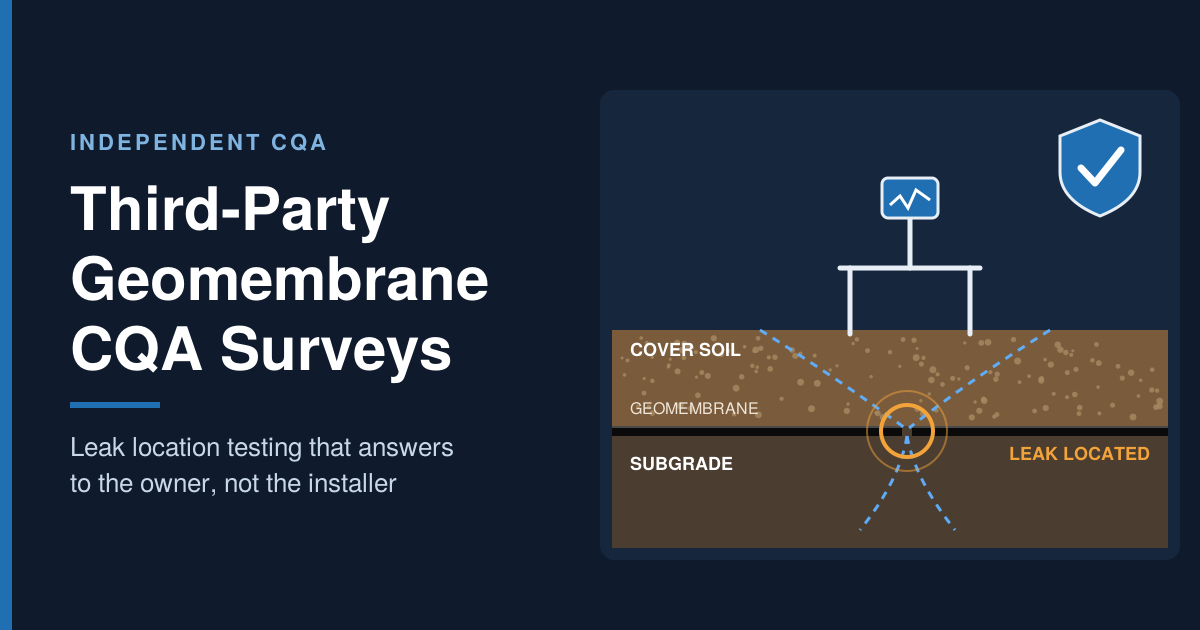
A geomembrane CQA survey is an independent quality assurance check, performed for the project owner, that confirms a liner was built to the approved design and locates holes through electrical leak location (ELL) testing. Third-party testing matters because the firm verifying the liner should have no financial stake in the installation.
Installers run their own quality control, and they should. The same crew that welds the seams, though, cannot also be the final word on whether the liner holds liquid. Separating those roles is the foundation of construction quality assurance on landfills, ponds, reservoirs, heap leach pads, and other lined containment.
What Is a Geomembrane CQA Survey?
A geomembrane CQA survey is the program of inspections, tests, and records that gives the owner and the permitting agency assurance that a liner system was constructed as specified. The U.S. EPA technical guidance Quality Assurance and Quality Control for Waste Containment Facilities (EPA/600/R-93/182, 1993) defines construction quality assurance this way and states that it is performed independently from the contractor’s quality control.
On a geomembrane project, CQA typically covers material conformance, observation of seam testing, documentation of panels and repairs, and an electrical leak location survey. The ELL survey is the step that checks the installed sheet itself for holes across the surveyed area instead of relying on seam samples alone.
What Is the Difference Between CQA and CQC on a Liner Project?
Construction quality control (CQC) is performed by the installer or contractor to control its own work, while construction quality assurance (CQA) is performed by a separate organization to verify that work on behalf of the owner. The EPA guidance puts it plainly for geosynthetics: the installer performs CQC, and an independent organization conducts CQA.
| Factor | Construction Quality Control (CQC) | Construction Quality Assurance (CQA) |
|---|---|---|
| Who performs it | Geosynthetics installer or earthwork contractor | An organization that operates separately from the contractor and the owner/operator |
| Who it answers to | The contractor, to meet the plans and specifications | The owner and the permitting agency |
| Core question | Is our work meeting the specification? | Was the facility built as designed? |
| Typical records | Installer QC logs, trial seams, seam test results | Daily reports, problem and corrective measures reports, certified final report |
Source: U.S. EPA, EPA/600/R-93/182 (1993).
Why Does Third-Party Geomembrane Testing Protect Project Owners?
Third-party geomembrane testing protects project owners because an independent leak location firm has no reason to overlook a defect. Every hole found is a repair the installer must make, and repairs cost crew time, materials, and schedule.
That incentive does not imply bad faith. It is a structural conflict, and good intentions do not remove it. When the installer hires or manages the leak location firm, the owner inherits several risks:
- Pressure to move quickly through complex areas such as sumps, pipe penetrations, and anchor trenches, where thorough testing takes the most time.
- Disputes over who pays for repairs when holes are found after cover placement, since the installer and the earthwork contractor each have a stake in the answer.
- Survey records that are harder to defend before a permitting agency because the tested party controlled the testing.
- A narrower skill set, since installation crews are trained in placement and seaming rather than interpreting ELL data across varied cover materials.
An independent firm reports to the owner or the owner’s CQA engineer, so its findings go straight to the party that carries the long-term liability for the containment.
When Does Geomembrane Damage Happen During Construction?
Geomembrane damage happens in two main phases: during installation, when seaming, handling, and foot traffic can leave holes in the exposed sheet, and during cover placement, when soil, drainage stone, and equipment can puncture or tear a liner that already passed inspection. A complete CQA program surveys after each phase.
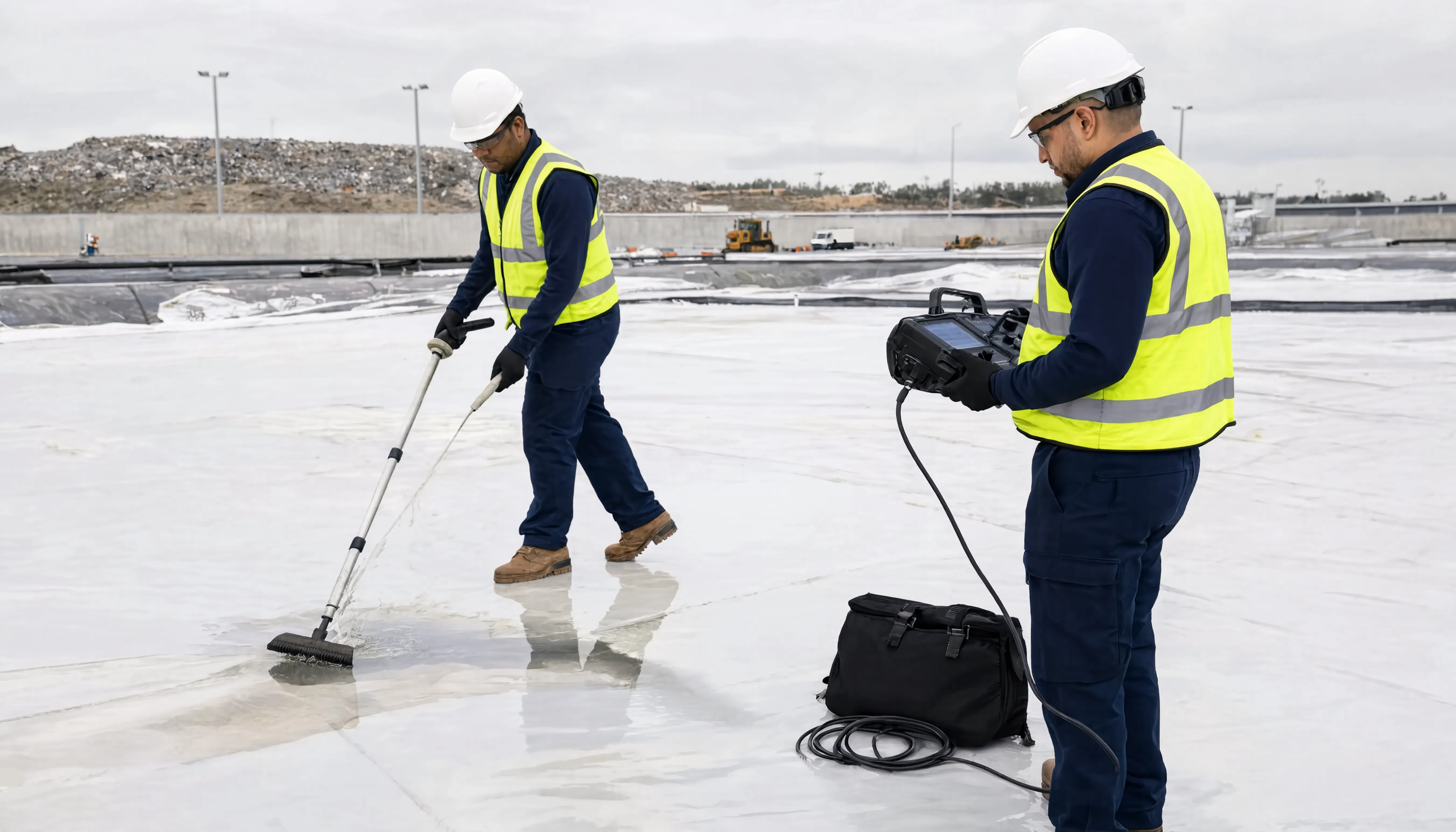
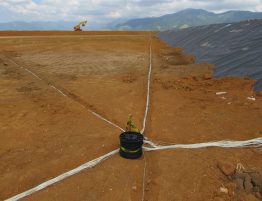
An exposed liner survey verifies the installation before anything is placed on top. Leak Location Services, Inc. performs bare liner leak location surveys on exposed geomembrane so repairs can be made while the sheet is still easy to reach.
A covered survey verifies the liner after cover material is placed. For earthen cover, a soil-covered geomembrane survey using the dipole method under ASTM D7007 locates holes through the operations layer.
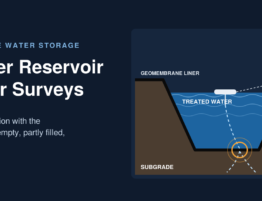
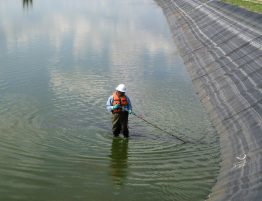
For ponds, lagoons, and reservoirs, water-covered liner surveys locate leaks while water is on the geomembrane. ASTM D7007 covers electrical methods for geomembranes covered with either water or earthen materials.
What Does a Geomembrane CQA Survey Report Include?
A geomembrane CQA survey report includes the documentation a regulator or future owner needs to confirm what was tested, how it was tested, and what was repaired. EPA guidance calls for daily inspection reports, inspection and test data sheets, problem identification and corrective measures reports, drawings of record, and a final report certified by the CQA certifying engineer.
The ELL portion of the report should stand on its own as evidence. Leak Location Services, Inc. survey reports document items such as:
- The facility, survey date, survey area, and cover conditions.
- The leak location method used and how it works.
- The leak detection sensitivity setting used during the survey.
- A figure showing the approximate location of each leak found.
- A description of each leak, including its type and size.
Ask for repair verification records as well, so the final CQA package shows that each hole was repaired and confirmed before the facility goes into service.
Do Regulators Expect Independent CQA for Liner Systems?
Regulatory guidance has long expected CQA to be independent of the installer. The EPA guidance recommends that CQA personnel and the CQA engineer be employed by an organization that operates separately from the contractor and the owner/operator, and that the CQA engineer be a registered professional engineer approved by the permitting agency (EPA/600/R-93/182, 1993).
The same guidance notes that most state and federal regulatory agencies require a written CQA plan to be submitted and approved before construction, usually as part of the permit application. Requirements for electrical leak location specifically vary by state, facility type, and permit, so confirm what the permit and CQA plan require before the work goes to bid.
How Do You Specify Independent Geomembrane Testing in an RFP?
Specify independent geomembrane testing by stating who hires the leak location firm, which ASTM methods apply, when surveys occur, and what the final report must contain. Clear language at the bid stage keeps the testing scope out of the installer’s contract.
- Engagement: Require the leak location firm to be contracted by the owner or the owner’s CQA engineer, with no contractual or financial relationship to the geomembrane installer.
- Methods: Reference ASTM D6747 for selecting electrical leak location techniques and ASTM D7007 for liners covered with water or earthen materials, plus the appropriate exposed-liner method for bare surveys.
- Timing: Schedule an exposed survey after installation and a covered survey after soil or water placement.
- Sensitivity: Require the firm to state and document the leak detection sensitivity for site conditions.
- Qualifications: Request documented ELL experience on comparable facilities, a project list, and the qualifications of field personnel.
- Design for testing: Address electrical isolation, cover thickness, and penetrations during design so site conditions support the survey.
- Deliverables: Define report contents, repair verification, and how findings feed into the certified CQA report.
Engineers drafting bid documents can review LLSI qualifications and survey specifications when writing the leak location section.
How Leak Location Services, Inc. Supports Independent CQA
Leak Location Services, Inc. (LLSI) is a San Antonio-based firm that has specialized in electrical leak location surveys of geomembranes since 1992. LLSI has surveyed more than half a billion square feet of geomembrane on projects ranging from about one acre to more than 200 acres.
Owners and CQA engineers can engage LLSI directly as the independent leak location contractor for exposed and covered geomembrane surveys, with reports built to fit into the certified CQA package. To scope a third-party survey, call 210.408.1241.
Frequently Asked Questions About Independent Geomembrane Surveys
Who should hire the geomembrane leak location firm?
The project owner or the owner’s CQA engineer should hire the geomembrane leak location firm. That arrangement keeps the survey independent of the installer whose work is being tested and sends findings directly to the party responsible for the facility and its permit. Avoid contract structures where the installer subcontracts, manages, or pays for the survey.
Does a bare liner survey replace a covered survey?
A bare liner survey does not replace a covered survey. A bare liner survey checks the geomembrane after installation, but soil, drainage stone, and equipment can puncture or tear the liner during cover placement. A covered survey, such as a dipole survey under ASTM D7007, is how damage created after the bare liner was accepted gets found.
Is installer seam testing enough to confirm a liner has no holes?
Installer seam testing is not enough to confirm a geomembrane has no holes. Seam tests check welded joints, while punctures, cuts, and equipment damage can occur anywhere in the sheet. An electrical leak location survey checks the surveyed liner area for holes and belongs in the CQA program, performed by a firm independent of the installer.
Is a geomembrane CQA survey required by regulation?
Whether a geomembrane CQA survey is required depends on the facility type, state rules, and permit conditions. EPA guidance notes that most state and federal agencies require an approved CQA plan before construction, but electrical leak location requirements vary. Check the permit and CQA plan, and specify the survey in bid documents so it is scoped and scheduled from the start.
What happens when a leak location survey finds a hole?
When a leak location survey finds a hole, the survey crew pinpoints and marks the location for investigation. On covered liners, the cover material is excavated to expose the geomembrane. The installer repairs the hole, the repair is verified, and the finding, repair, and verification are recorded in the CQA documentation provided to the owner and regulator.
For an independent geomembrane CQA survey on a landfill, pond, reservoir, or mining facility, contact Leak Location Services, Inc. at 210.408.1241.