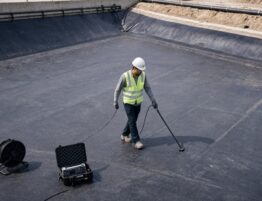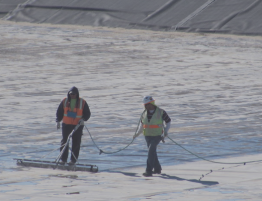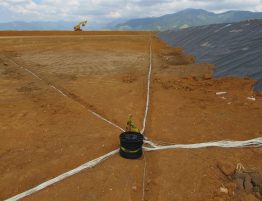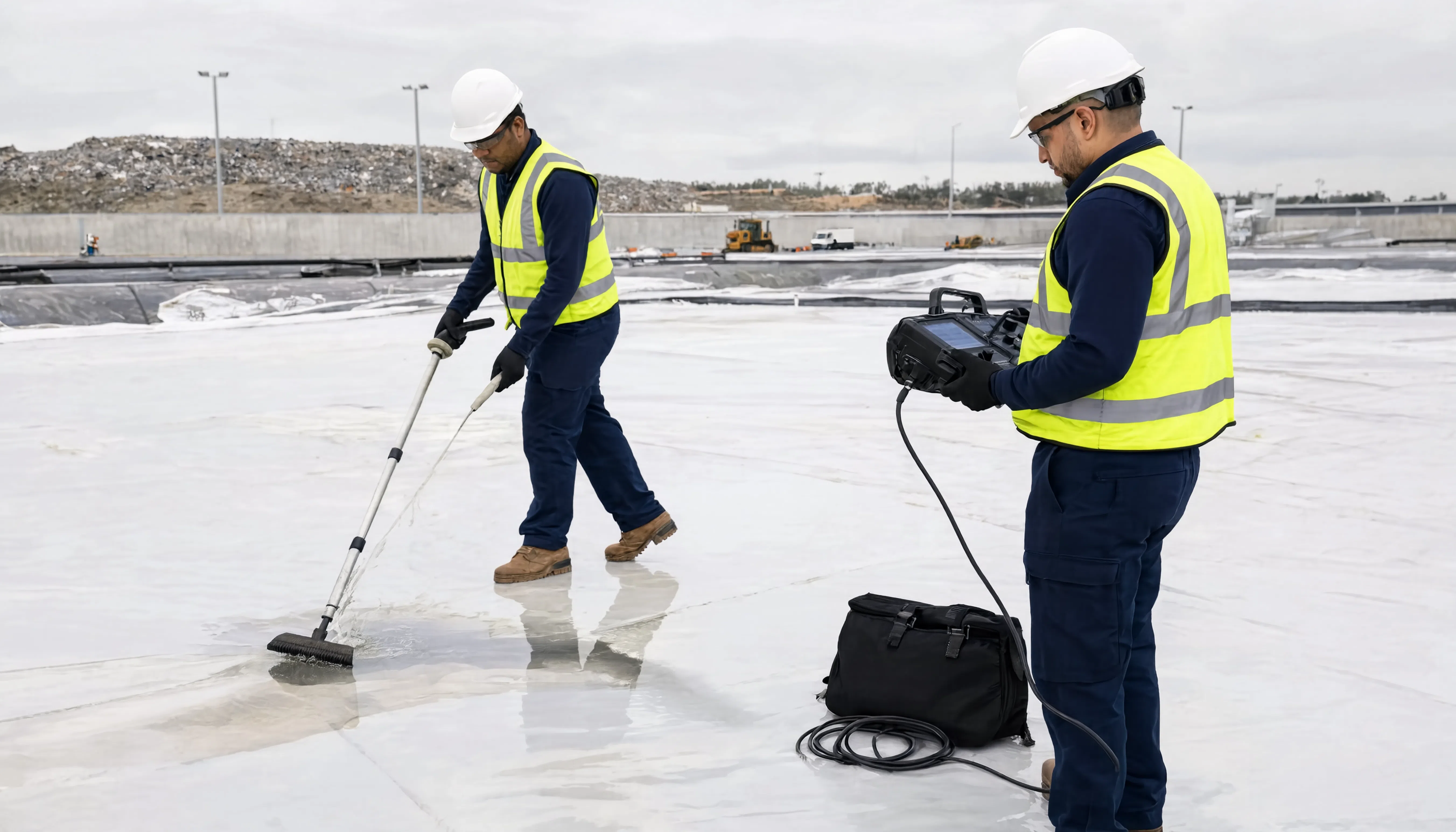
Heap leach pad leak detection is most reliable when done with an electrical leak location (ELL) survey. ELL tests the entire geomembrane under the pad, not just the seams. Because an HDPE liner is an electrical insulator, current applied across it can only pass through holes, so survey crews can locate each leak for repair before ore stacking or while ponds stay in service.
This guide covers why mining liners fail, what one well-documented Nevada site shows about the stakes, which survey methods fit heap leach pads and process ponds, and how to prepare a site so the survey delivers usable results.
Why Does Heap Leach Pad Leak Detection Matter?
A heap leach pad liner holds back metal-bearing solution that is both valuable and hazardous. Every leak loses recoverable metal and creates a pathway to soil and groundwater. Once ore is stacked, reaching the liner to find a leak becomes expensive and slow.
Electrical leak location became a commercial technology around 1985 and was widely used by the 1990s. It is now being applied to heap leach facilities in the mining industry, according to a paper published by the International Geosynthetics Society. The ASTM practice for mapping leaks, ASTM D8265, specifically lists ore and waste pads among the facilities where leak location surveys can be used.
What Can the Arimetco Heap Leach Pads Teach Mine Operators?
The former Arimetco heap leach operation at the Anaconda Copper Yerington Mine in Nevada is one of the most thoroughly documented cases of heap leach containment problems in the U.S. The figures below come from the U.S. EPA Remedial Investigation Report for Arimetco Operable Unit 8 (2008).
- Liner system: Several of the pads were built on a single 40-mil HDPE liner. Later phases used a 40-mil HDPE primary liner over compacted clay.
- Solution volume: The raffinate applied to the heaps contained about 12 grams of sulfuric acid per 1,000 grams of water. Pregnant leach solution (PLS) flowed to processing at rates that normally exceeded 5,000 gallons per minute.
- After shutdown: When operations stopped, an estimated 90 million gallons of PLS remained in the heaps. The pumping system was still handling about 1,200 gallons per minute in January 2000.
- Fluid chemistry: Drain-down samples had pH values of 1.9 to 2.8. The report found aluminum, copper, and pH at levels acutely lethal to birds and mammals.
- Liner performance: The ponds and ditches serving the heaps had shown leakage through primary liners into their leak detection systems. In 2006, EPA relined one PLS pond that had historically leaked.
The remedy selected in the 2017 Record of Decision includes regrading and capping the heap leach pads and rebuilding the fluid management and evaporation pond system, according to EPA’s site profile.
Arimetco was an abandonment case, not a typical operating mine. But it shows how quickly liner problems compound when large volumes of acidic solution sit on a single liner, and why finding leaks early costs far less than managing them for decades.
Where Do Heap Leach Pad Liners Get Damaged?
Most damage happens during construction, after the liner has already passed seam testing. ASTM D7007-24 identifies construction damage from machinery placing earthen material on the geomembrane as the most significant cause of leaks in covered liners.
On a heap leach pad, that covers several high-risk steps:
- Spreading overliner or drain rock with dozers
- Installing solution collection pipes in the drainage layer
- Traffic over rocks or debris trapped under or on the liner
- Poorly prepared subgrade that concentrates stress under the weight of the heap
Seam testing checks welds, not the full panel surface. Visual inspection stops working once the liner is covered. Only a geoelectric survey can find holes through the cover layer. For a closer comparison of these approaches, see our guide to electrical and traditional geomembrane leak detection methods.
Which Survey Methods Work on Mining Containment?
The right method depends on what covers the liner when it is tested. Most mining projects use more than one.
| Facility or stage | Survey method | ASTM practice | What it finds |
|---|---|---|---|
| Pad liner after seaming, before overliner | Bare liner (water puddle, spark, or arc) | D7002, D7240, D7953 | Installation defects while the liner is exposed |
| Pad liner after overliner or drain rock placement | Soil-covered (dipole) survey | D7007, D8265 | Damage caused while placing the cover, before ore stacking |
| PLS, raffinate, and process ponds | Water-covered survey (wading or towed) | D7007 | Leaks in ponds that are filled or in service |
Sources: ASTM D7007-24, ASTM D8265-21.
Bare liner surveys
A bare liner survey is the final check after seaming and standard CQA, before any cover goes down. The water puddle method is the most common. Spark testing is used on conductive-backed liners, and arc testing on non-conductive liners where water is impractical.
Soil-covered surveys
A soil-covered geomembrane survey is performed after the overliner is placed. It tests the liner after construction loading has occurred, which makes it the main defense against dozer and placement damage on a new pad.
Water-covered surveys
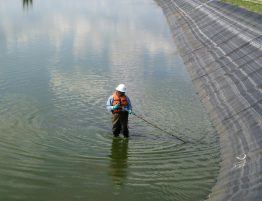
Water surveys of lined ponds can be done without draining. Crews wade when water is 6 to 30 inches deep and use a towed sensor for deeper water or water unsafe for wading. We routinely survey ponds holding brine and other chemicals.
What Do Nevada Rules Require of Leach Pad Liners?
Nevada, a major heap leach state, sets minimum design criteria for leach pads in NAC 445A.434. Pads must exert only minimal hydraulic head on the liner, and containment must be equal to or better than a synthetic liner over a 12-inch prepared soil subbase with low permeability. Any drainage material installed beneath a single liner must function as a leak detection system with a way to recover fluids.
These rules set design standards. Whether an ELL survey is required depends on the permit and the regulator. Even where it is not required, a documented survey gives operators evidence that the liner was checked and repaired before loading.
How Should You Prepare a Mining Site for an ELL Survey?
Site preparation determines whether a survey produces clear results. Plan these items before the survey crew arrives:
- Provide conductive material on both sides. ELL needs water, soil, or a GCL above and below the tested liner. In arid mining regions, the cover may need wetting before testing. Yerington, Nevada, for example, averages about 5.13 inches of precipitation a year, per the EPA report.
- Isolate conductive penetrations. Metal pipes, flange bolts, steel drains, and batten strips must be isolated so they do not mask leak signals, as described in ASTM D6747-21.
- Plan for double-lined systems. Only the uppermost (primary) geomembrane is tested. Primary slopes with no conductive material beneath them may require a conductive geomembrane, so decide this during design.
- Set pond water levels. For wading surveys, keep water between 6 and 30 inches. Deeper ponds use the towed method.
- Schedule the survey before ore stacking. Once ore is placed, finding and repairing a leak requires excavation.
- Use an independent tester. A leak location company with no ties to the manufacturer or installer removes any conflict of interest from the results.
Why Choose an Independent Leak Location Company for Mining Projects?
Leak Location Services, Inc. (LLSI) is fully independent, with no ties to geomembrane manufacturers or installers, and leak location surveys are our only business. Our founders began developing geoelectric leak location at Southwest Research Institute in 1980, and LLSI has performed more than 4,378 surveys covering over 720 million square feet of geomembrane. Our technical staff has more than 92 years of combined commercial leak location experience. We design and fabricate our own survey equipment and have completed projects in 28 countries.
“LLSI has consistently proven their experience and technical know-how on even the most demanding projects, especially soil covered surveys.” — Ron Frobel, PE, RK Frobel & Associates
Review our qualifications and specification guidance for staff experience and survey requirements.
Frequently Asked Questions About Heap Leach Pad Leak Detection
Why isn’t seam testing enough for a heap leach pad?
Seam testing checks only welded joints, not the panel surfaces between them. On a heap leach pad, much of the damage happens when overliner or drain rock is spread over the liner, which occurs after seam testing is done. ASTM D7007 identifies machinery damage during cover placement as the leading cause of leaks in covered geomembranes.
When should a heap leach pad liner be surveyed?
Ideally twice. A bare liner survey after seaming finds installation defects while the liner is exposed. A soil-covered survey after the overliner is placed finds construction damage before ore stacking begins. Both windows should be built into the construction schedule during design.
Can you survey a PLS or process pond that is still in use?
Yes. Water-covered surveys locate leaks without draining the pond. Crews wade in water between 6 and 30 inches deep or use a towed sensor in deeper water. LLSI routinely surveys ponds that contain brine and other chemicals.
Can ELL test a double-lined pond or pad?
Yes, but only the uppermost (primary) geomembrane is tested. The method requires conductive material above and below that liner. On primary slopes where no conductive material sits beneath the liner, a conductive geomembrane may be needed, so this should be addressed in design.
Does a dry climate affect a mining ELL survey?
It can. Soil-covered surveys need enough moisture in the cover and below the liner to carry current. In arid regions, operators often wet the cover before testing. The survey team should specify target moisture conditions during project scoping.
Schedule a Mining Geomembrane Leak Location Survey
Finding leaks before ore stacking, and checking process ponds while they stay in service, costs far less than recovering lost solution or remediating contamination later. LLSI can recommend the right survey methods for your pads and ponds and help you schedule them around construction milestones.
Call 210.408.1241 or request an estimate for your mining project.