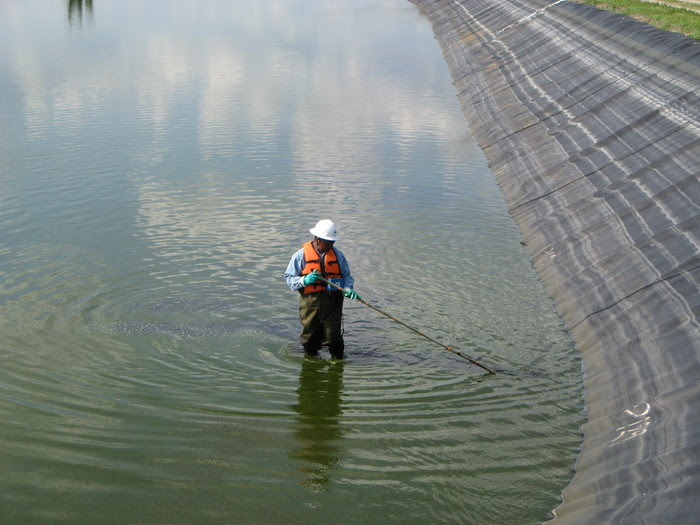
Leak location surveys are a critical quality assurance and quality control process used to detect leaks in geomembrane liner systems. These liners are widely used in environmental, mining, industrial, and water containment applications to prevent leaks that could result in contamination, material loss, or regulatory noncompliance. In the simplest terms, leak location surveys identify breaches, defects, or imperfections in a liner system so they can be repaired before causing costly or irreversible damage. As geomembrane installations become larger and more complex worldwide, reliable leak detection has become an essential component of responsible facility design and operation.
Understanding Geomembranes and Their Purpose
Geomembranes are synthetic membranes, typically manufactured from materials such as HDPE, LLDPE, PVC, or polypropylene. They are engineered to act as impermeable barriers and are commonly installed in applications including landfills, heap leach pads, tailings facilities, ponds, reservoirs, canals, and secondary containment systems.
The primary purpose of a geomembrane is containment. Any breach in the liner compromises its function and can lead to environmental impacts, regulatory penalties, and financial loss. Even small defects, such as pinholes or seam imperfections, can allow liquids to migrate through the liner system over time.
Why Geomembrane Leak Detection Is Essential
Leak detection is not simply a best practice. In many jurisdictions, it is a regulatory or contractual requirement. Undetected leaks can result in long-term issues that are far more expensive to address after construction or during operation.
Key reasons geomembrane leak detection is essential include:
- Protecting the environment from contamination
- Ensuring compliance with environmental regulations
- Reducing long-term maintenance and remediation costs
- Verifying installation quality before system commissioning
- Extending the service life of containment systems
- Providing documented assurance to owners, engineers, and regulators
Electrical leak location surveys allow defects to be identified with pinpoint accuracy so repairs can be completed efficiently and correctly.
Common Causes of Geomembrane Leaks
Leaks can occur at various stages of a project, from manufacturing to installation and operation. Understanding common causes highlights why thorough leak detection is necessary.
Typical causes include:
- Manufacturing defects such as thin spots or pinholes
- Damage during transportation or handling
- Improper seaming or welding errors
- Punctures from subgrade materials or equipment
- Damage caused by foot traffic or heavy machinery
- Degradation due to chemical exposure or UV radiation
- Stress from settlement or thermal expansion
Many of these defects are not visible to the naked eye, making electrical leak location methods the most reliable way to identify them.
How Electrical Leak Location Surveys Work
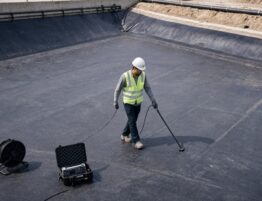
Electrical leak location surveys are the industry standard for geomembrane leak detection. These methods use electrical current to locate breaches in nonconductive geomembranes installed over conductive subgrades or water.
The principle is straightforward. An electrical current is applied across the liner system. Where the geomembrane is intact, the current cannot pass through. Where a defect exists, the current flows through the breach to the conductive layer below, allowing technicians to locate the exact position of the leak.
Electrical leak location methods are highly accurate and can identify defects as small as a pinhole.
Types of Electrical Leak Location Methods
Several electrical leak location techniques are used depending on project conditions, liner configuration, and whether the system is exposed or covered.
Water Puddle Method
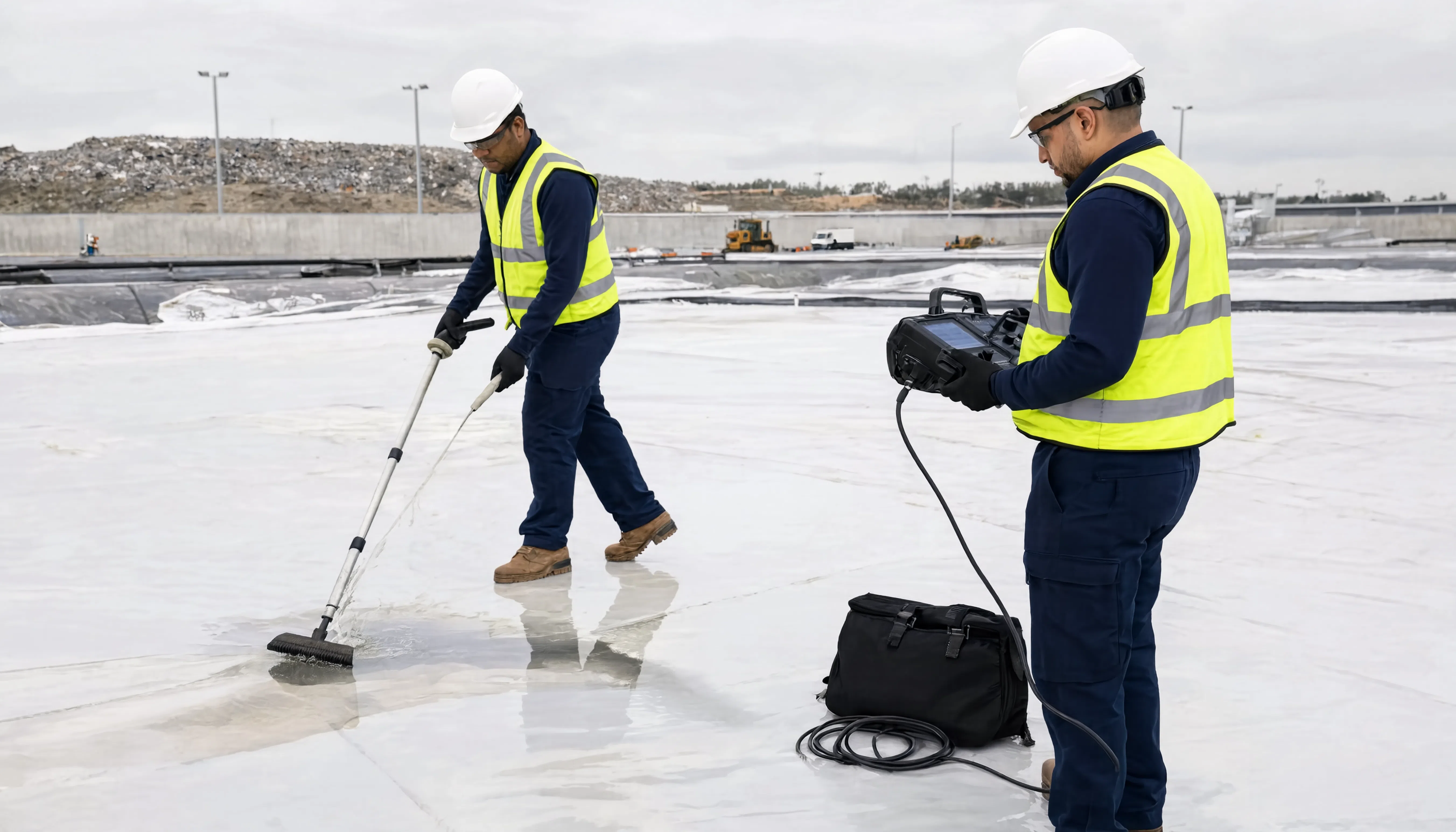
The water puddle method is used on exposed geomembranes. A thin layer of water is placed on the liner surface, and a probe is used to detect electrical flow through defects.
This method is ideal for:
- Landfills and ponds before cover placement
- Flat or sloped surfaces
- Projects requiring high sensitivity
Spark or Arc Testing Method
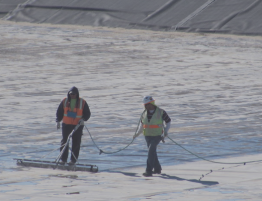
Arc testing is used on exposed geomembranes and does not require water. A high voltage spark is passed over the surface, and visible or audible signals indicate defects.
This method is often used for:
- Dry conditions
- Conductive liner (Spark) non-conductive liner (Arc)
- Newly installed liner
- Situations where water use is limited
Dipole Method
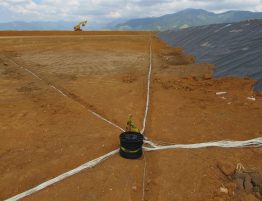
The dipole method is used when geomembranes are covered with soil, aggregate, or protective layers. Electrodes are placed on the surface, and technicians measure voltage differences to locate leaks beneath the cover.
This method is essential for:
- Post installation verification
- Operational facilities
- Systems where the liner is no longer exposed
When Should Geomembrane Leak Detection Be Performed?
Timing is critical for effective leak detection. Surveys can be conducted at multiple stages to ensure long-term performance.
Common survey stages include:
- After geomembrane installation and seaming
- Before placement of cover materials
- After cover placement using covered liner methods
- During operation to investigate suspected leaks
- As part of routine assessments
Early detection allows defects to be repaired when access is easiest, and repair costs are lowest.
Benefits of Professional Leak Detection Services
While some testing methods may appear straightforward, professional experience and specialized equipment are essential for reliable results. Qualified survey providers understand how to interpret electrical signals, adapt methods to site conditions, and deliver defensible documentation.
Benefits of using an experienced leak detection provider include:
- Accurate identification of leak locations
- Minimal disruption to construction or operations
- Comprehensive reporting and documentation
- Compliance with international standards and specifications
- Reduced risk of false positives or missed defects
Applications Across Industries
Geomembrane leak detection is used across a wide range of industries worldwide.
Key applications include:
- Municipal and hazardous waste landfills
- Mining heap leach pads and tailings storage facilities
- Oil and gas secondary containment systems
- Water and wastewater treatment ponds
- Agricultural and industrial lagoons
- Decorative and recreational water features
Each application presents unique challenges that require tailored survey approaches and experienced personnel.
Regulatory and Quality Assurance Considerations
Many environmental regulations and engineering specifications require leak detection testing as part of construction quality assurance programs. Electrical leak location surveys provide objective, measurable results that satisfy regulatory oversight and stakeholder expectations.
Documentation typically includes:
- Survey methodology and equipment used
- Test conditions and coverage areas
- Leak locations identified and marked
- Repair verification results
This documentation is invaluable for project closeout and long-term facility management.
Choosing the Right Leak Detection Partner
Selecting a qualified leak detection provider is just as important as selecting the liner material itself. Experience, global reach, and technical expertise directly impact survey quality and reliability.
When evaluating providers, consider:
- Years of experience in electrical leak location surveys
- International project experience and adaptability
- Range of testing methods offered
- Commitment to safety and quality standards
- Clear and thorough reporting practices
- Ability to work with owners, engineers, and contractors
Contact Leak Location Services, Inc. Today
Geomembrane leak detection is a vital safeguard for containment systems in environmental, industrial, and mining applications. Electrical leak location surveys provide the most accurate and reliable means of identifying defects, protecting investments, and ensuring regulatory compliance. With the increasing scale and complexity of geomembrane installations worldwide, professional leak detection is no longer optional. It is essential.
Leak Location Services, Inc. is an international leader specializing exclusively in Electrical Leak Location Surveys of geomembranes. With over 33 years of experience, we deliver first-class surveys for clients around the world, providing accuracy, reliability, and confidence in liner integrity. To learn more about how our proven expertise can support your project, contact our team today.