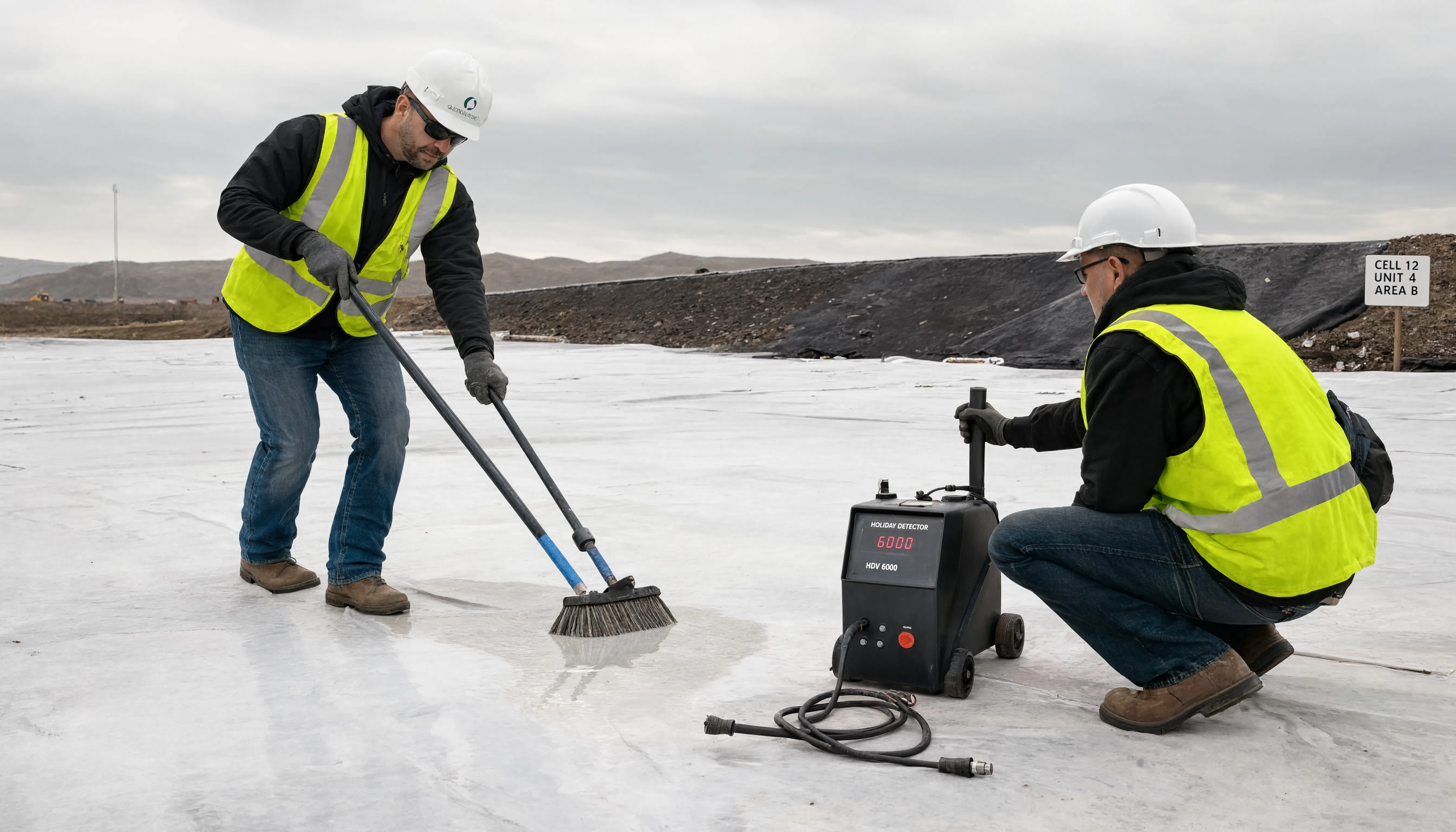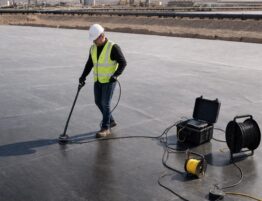
Landfill Subtitle D liner testing confirms that a municipal solid waste landfill liner meets 40 CFR Part 258 and any stricter state rules. The federal rule sets the composite liner design but names no leak test, so states, permits, and specifications decide how the installed geomembrane is checked. Electrical leak location (ELL) surveys find holes across the full liner area.
What Is Subtitle D and Who Has to Comply?
Subtitle D of the Resource Conservation and Recovery Act (RCRA) covers nonhazardous solid waste. EPA’s criteria for municipal solid waste landfill (MSWLF) units are codified at 40 CFR Part 258, which sets minimum national standards for location, operation, design, groundwater monitoring, corrective action, closure, and post-closure care.
The criteria apply to facilities that accept municipal solid waste. States with EPA-approved programs carry out most permitting and inspection, and they can set requirements that go beyond the federal floor. In practice, a landfill owner answers to two rulebooks: Part 258 and the state solid waste regulations written into the facility permit.
What Are the Subtitle D Composite Liner Requirements?
New MSWLF units and lateral expansions must be built either to a state-approved performance design or with a composite liner and a leachate collection system. The composite liner pairs a geomembrane with low-permeability compacted soil, and the two must be in direct, uniform contact so the soil limits flow through any hole in the membrane.
| Component | Federal minimum |
|---|---|
| Upper component: flexible membrane liner (FML) | 30 mil minimum; HDPE geomembranes at least 60 mil |
| Lower component: compacted soil | At least 2 feet thick, hydraulic conductivity no more than 1 × 10⁻⁷ cm/sec |
| Installation | FML in direct and uniform contact with the compacted soil |
| Leachate collection system | Designed to keep less than 30 cm of leachate over the liner |
Source: 40 CFR 258.40, Design Criteria (eCFR).
What about alternative designs?
The Director of an approved state can accept a design other than the standard composite liner if it keeps the chemical concentrations listed in Table 1 of 258.40 from being exceeded in the uppermost aquifer at the relevant point of compliance. That point must sit no more than 150 meters from the waste unit boundary, on land the owner controls.
An alternative design still depends on the geomembrane performing as designed. A hole that lets leachate through undercuts the performance demonstration just as it would in a standard composite liner.
Where Do Geomembrane Holes Come From?
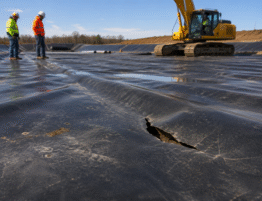
The regulation sets the design, but construction is where geomembranes get damaged. Holes found by leak location surveys typically trace back to a handful of activities:
- Stones or debris in the subgrade pressed through the liner
- Equipment, foot traffic, and tools during deployment and welding
- Placement of drainage aggregate or protective soil over the liner
- Detail work at pipe penetrations, boots, sumps, and anchor trenches
Cover placement deserves special attention. Once the drainage layer goes down, visual inspection can no longer see the geomembrane, and the machinery spreading that material is a common source of damage. Finding and repairing those holes before waste placement costs far less than chasing a leak after the cell is in service.
How Do State Programs Go Beyond the Federal Floor?
States may adopt rules stricter than Part 258, so the federal minimums are rarely the whole picture. Requirements vary by state and often by permit, and they can include:
- Double-liner systems with a leak detection layer between liners
- Thicker geomembranes or specific material specifications
- Leak location surveys of the installed geomembrane, before or after cover placement
- Independent construction quality assurance (CQA) oversight
- Agency review of the CQA certification before the cell can receive waste
Confirm early in design whether your permit or specifications call for an ELL survey and at which construction stage. Building the survey into the schedule from the start avoids delays when the certification package goes to the agency.
How Does ELL Support Landfill Subtitle D Liner Testing?
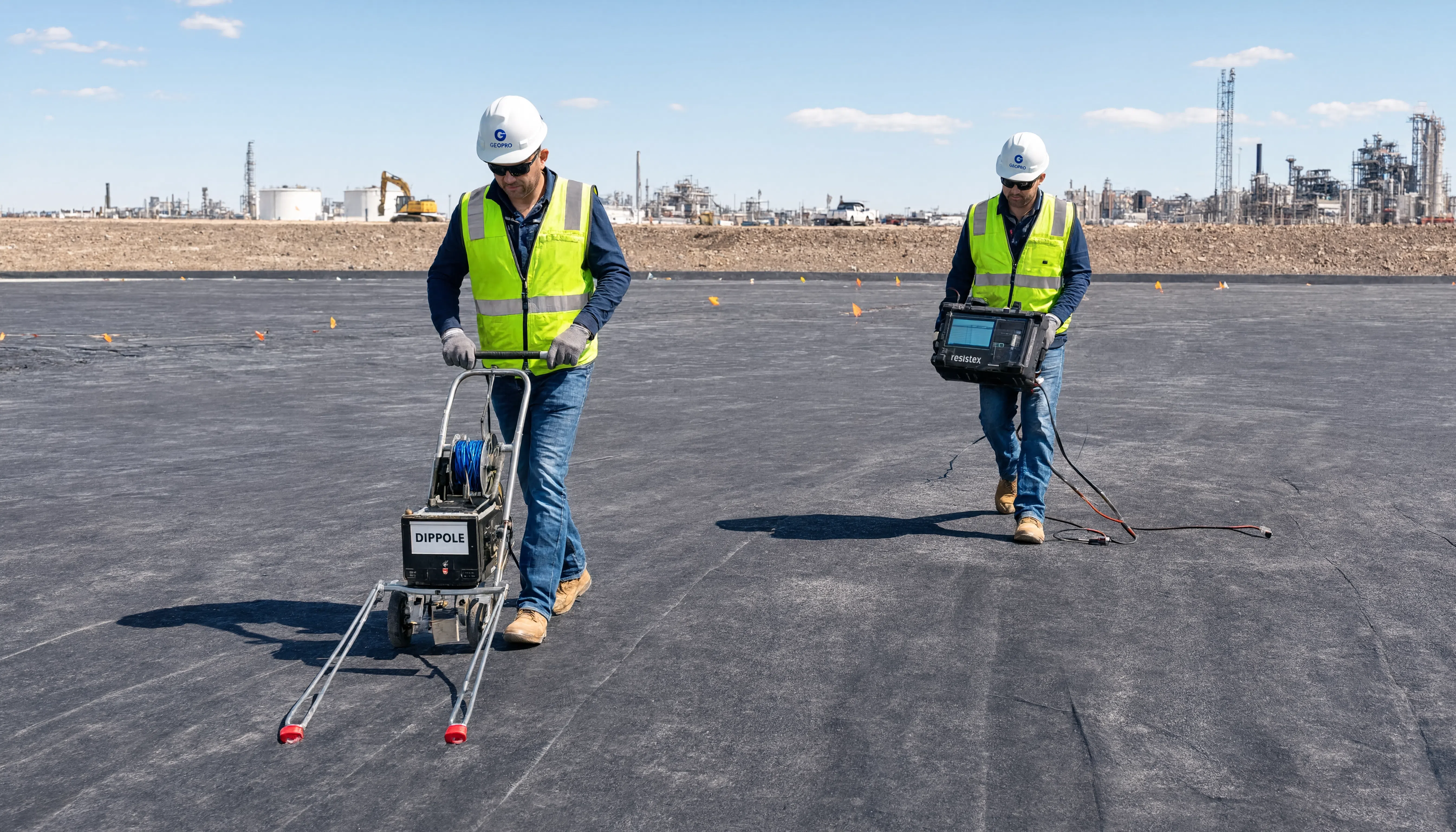
ELL places a voltage across the geomembrane, which acts as an electrical insulator, and locates the spots where current flows through holes in it. Because only a hole can complete the circuit, the survey pinpoints defects across the entire surveyed area rather than at sampled locations. In a composite liner, the compacted soil beneath the geomembrane typically provides the conductive layer the survey needs.
ASTM D6747 is the guide for selecting among electrical leak location techniques. The right method depends on whether the geomembrane is exposed or covered:
| Liner condition | Method | ASTM reference |
|---|---|---|
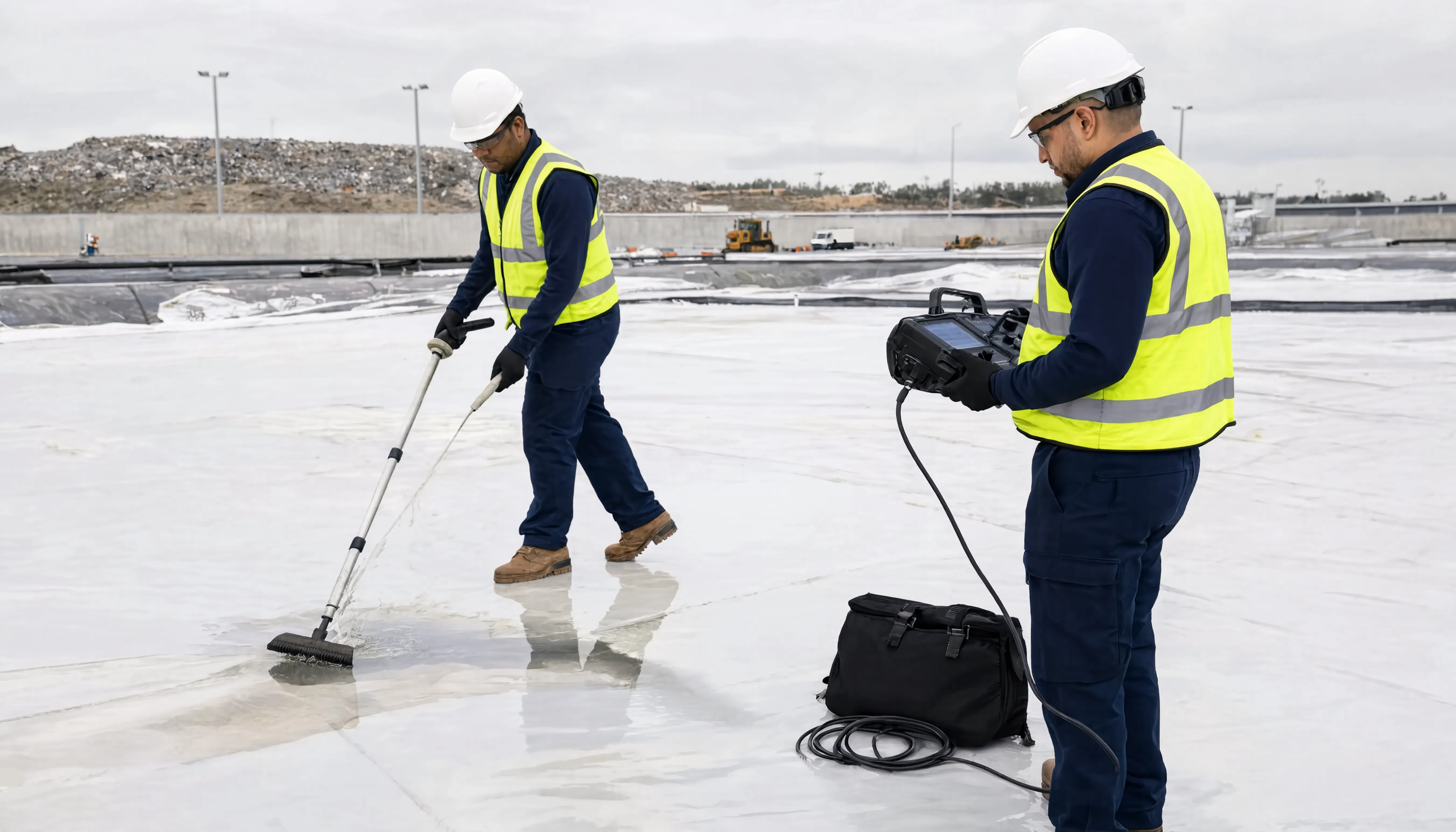
| Exposed geomembrane | Water puddle | D7002 |
| Exposed geomembrane | Water lance | D7703 |
| Exposed geomembrane | Arc testing | D7953 |
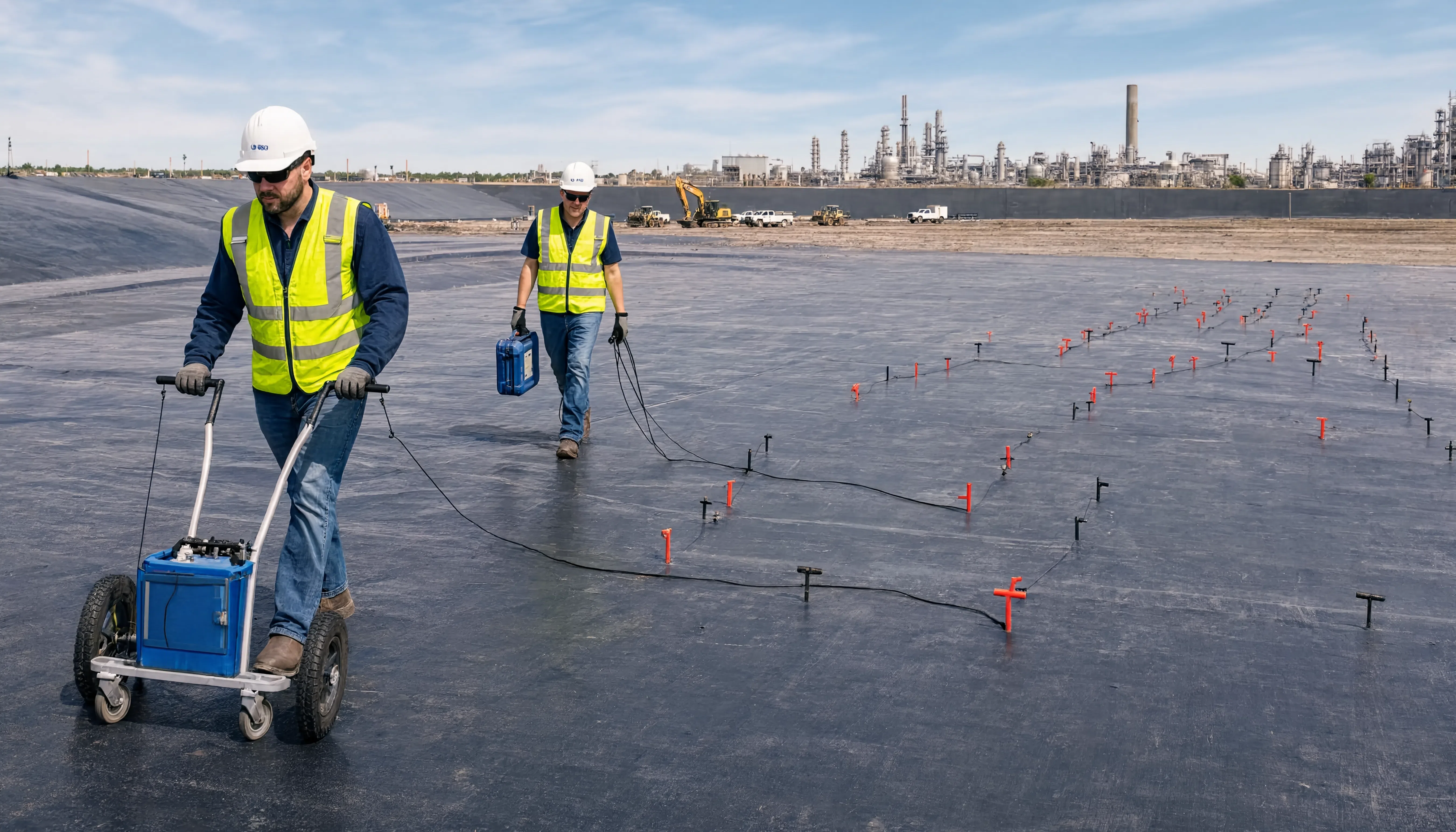
| Covered with soil or water | Dipole method | D7007 |
| Covered with soil or water | Mapping method | D8265 |
For landfill cells, the two stages map to two survey types. Bare liner surveys check the exposed geomembrane after installation and before anything is placed on it. Soil surveys of covered geomembranes run after the drainage or protective layer is spread, which is when cover-placement damage shows up.
Why does ELL carry weight with regulators?
ELL produces objective, documented evidence that the installed liner was surveyed for holes and that every detected hole was repaired and retested. That evidence fits directly into the CQA certification agencies review before authorizing waste placement. It covers the full surveyed area, works after cover placement when visual inspection cannot, and follows published ASTM practices that engineers can cite in specifications.
What Should ELL Add to the CQA Record?
CQA is the independent verification that the liner system was built to the approved design, permit, and specifications. Regulators typically expect a CQA plan before construction and a certification report afterward, and the ELL report belongs in that report as a supporting document.
A complete leak location survey report should include:
- Project description, liner system, and the area surveyed
- Survey method, equipment, and the ASTM practice followed
- Sensitivity test results confirming the setup could detect a leak under site conditions
- Site conditions during the survey
- Location and description of each detected leak, with a map or drawing
- Repair records and retest confirmation
- A final statement of survey results
To keep agency review comments to a minimum, coordinate the ELL scope with the CQA engineer before construction. Confirm that pipe penetrations and other grounded elements are isolated so they do not mask leak signals, and retain the survey data with the as-built drawings. Clear leak locations also show which construction activity caused damage, so crews can adjust methods on later cells.
How Does Liner Quality Affect Post-Closure Care?
Under 40 CFR 258.61, owners must conduct post-closure care for 30 years after closure, and the Director of an approved state can shorten or lengthen that period. Post-closure care covers maintaining the final cover, operating the leachate collection system, monitoring groundwater, and monitoring landfill gas (40 CFR 258.61, Cornell Legal Information Institute).
Every hole repaired before waste placement is one less path for leachate during those decades of monitoring. A bottom liner surveyed and repaired at construction gives the owner a documented starting condition, which matters if groundwater data ever shows an anomaly. Final cover systems that use a geomembrane can be surveyed the same way, since holes in the cap let water into the waste and add to leachate generation.
Frequently Asked Questions
What does landfill Subtitle D liner testing involve?
It covers everything that verifies the liner meets 40 CFR Part 258 and the state permit: material conformance testing, seam testing, CQA observation, and, where the permit or specification calls for it, an electrical leak location survey of the installed geomembrane. The results are compiled in the CQA certification report the state agency reviews before the cell receives waste.
Does Subtitle D require electrical leak location surveys?
The federal rule sets design and performance criteria but does not name a specific leak test. Whether an ELL survey is required depends on your state regulations, facility permit, and project specifications. Many owners and engineers specify ELL regardless, because it is the method that locates holes across the full liner area. Confirm requirements with your regulator and CQA engineer early in design.
What is the minimum geomembrane thickness for a Subtitle D composite liner?
Under 40 CFR 258.40, the flexible membrane liner must be at least 30 mil thick, and HDPE geomembranes must be at least 60 mil. It sits over at least two feet of compacted soil with hydraulic conductivity no greater than 1 × 10⁻⁷ cm/sec. State programs and permits may require thicker liners or additional layers.
Can an ELL survey be performed after soil cover is placed?
Yes. The dipole method (ASTM D7007) and the mapping method (ASTM D8265) are designed for geomembranes covered with soil or water. Surveying after the drainage or protective layer is placed finds damage caused by the cover placement itself, which an exposed-liner survey done earlier cannot catch. Many projects specify both a bare liner survey and a covered survey.
How do you know an ELL survey can find small holes on a given site?
Each survey includes a sensitivity test, in which the crew measures the signal from an artificial leak placed under actual site conditions. If the equipment detects it, the survey setup is confirmed for that area. Soil moisture, cover thickness, and isolation of grounded elements all affect detection, which is why the sensitivity results belong in the survey report.
Plan Your Subtitle D Leak Location Survey
Meeting Subtitle D means showing that the installed liner performs as designed, not just that the design was approved. Leak Location Services, Inc. is an international company specializing in electrical leak location surveys of geomembranes, with decades of field experience on landfill liners and ASTM-compliant survey methods. Explore our geomembrane leak location survey services, or review our qualifications and specification guidance and contact us to scope a survey for your next landfill cell.