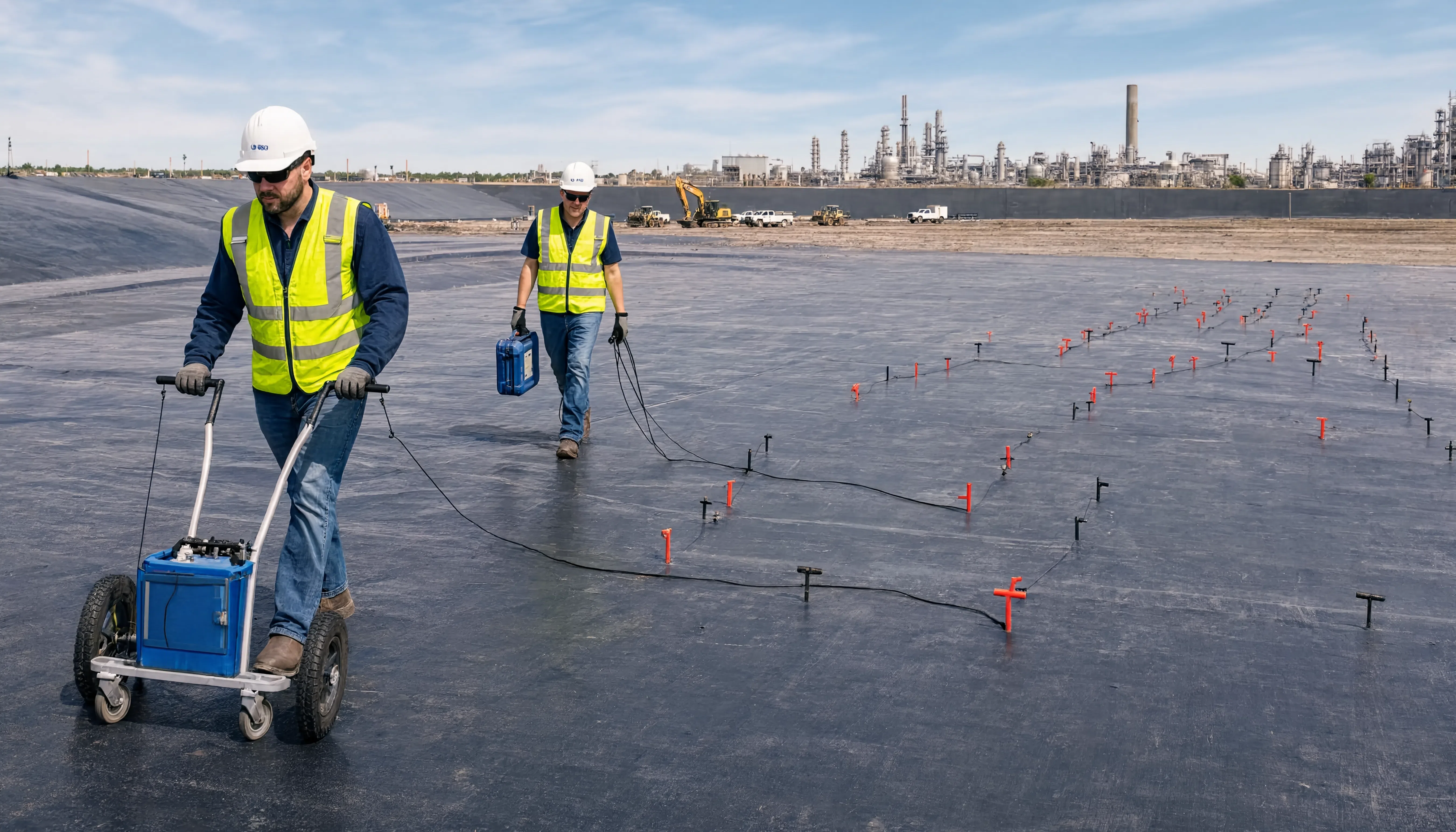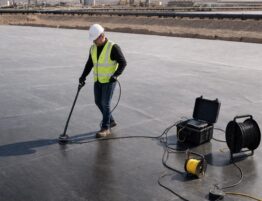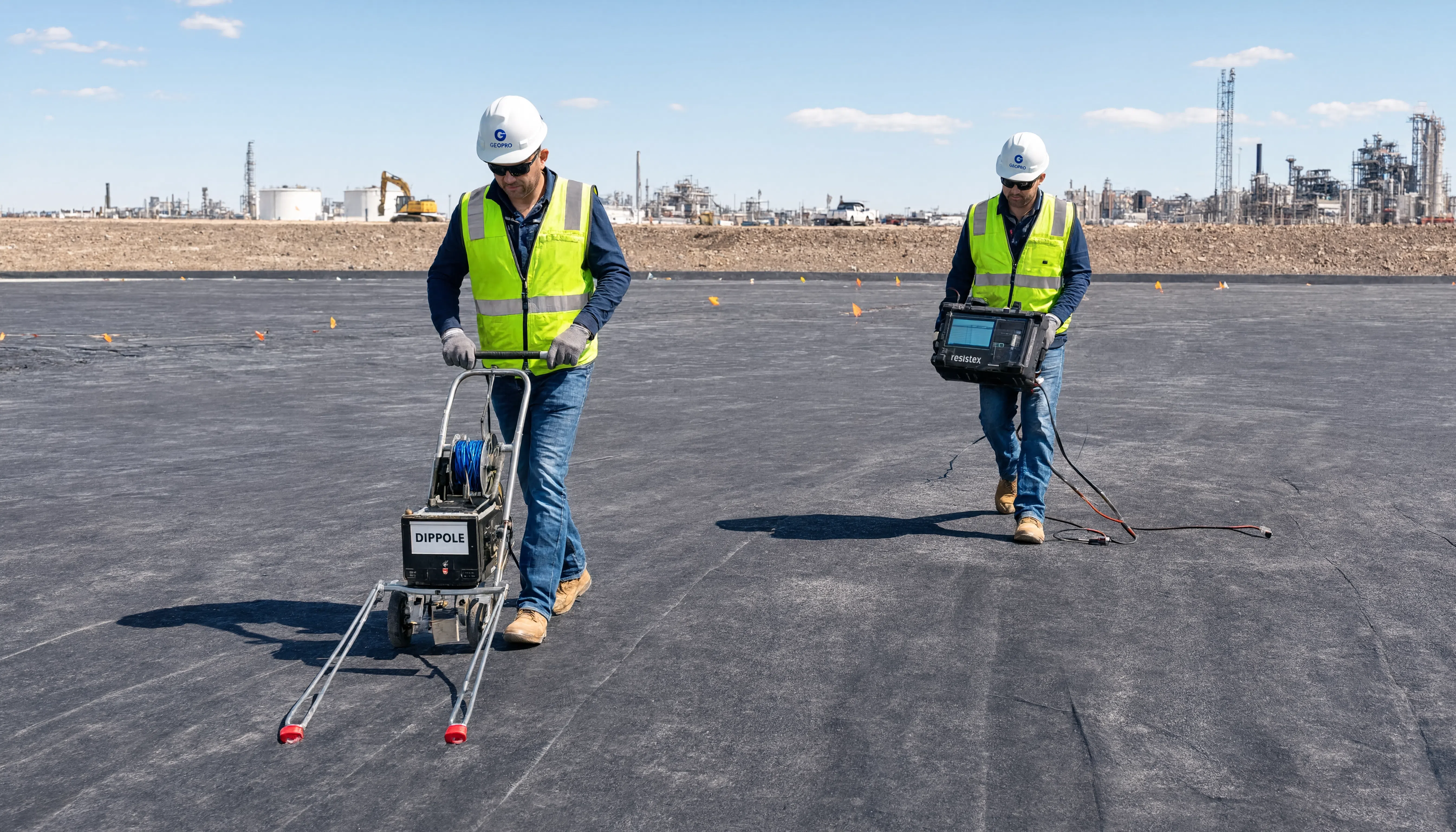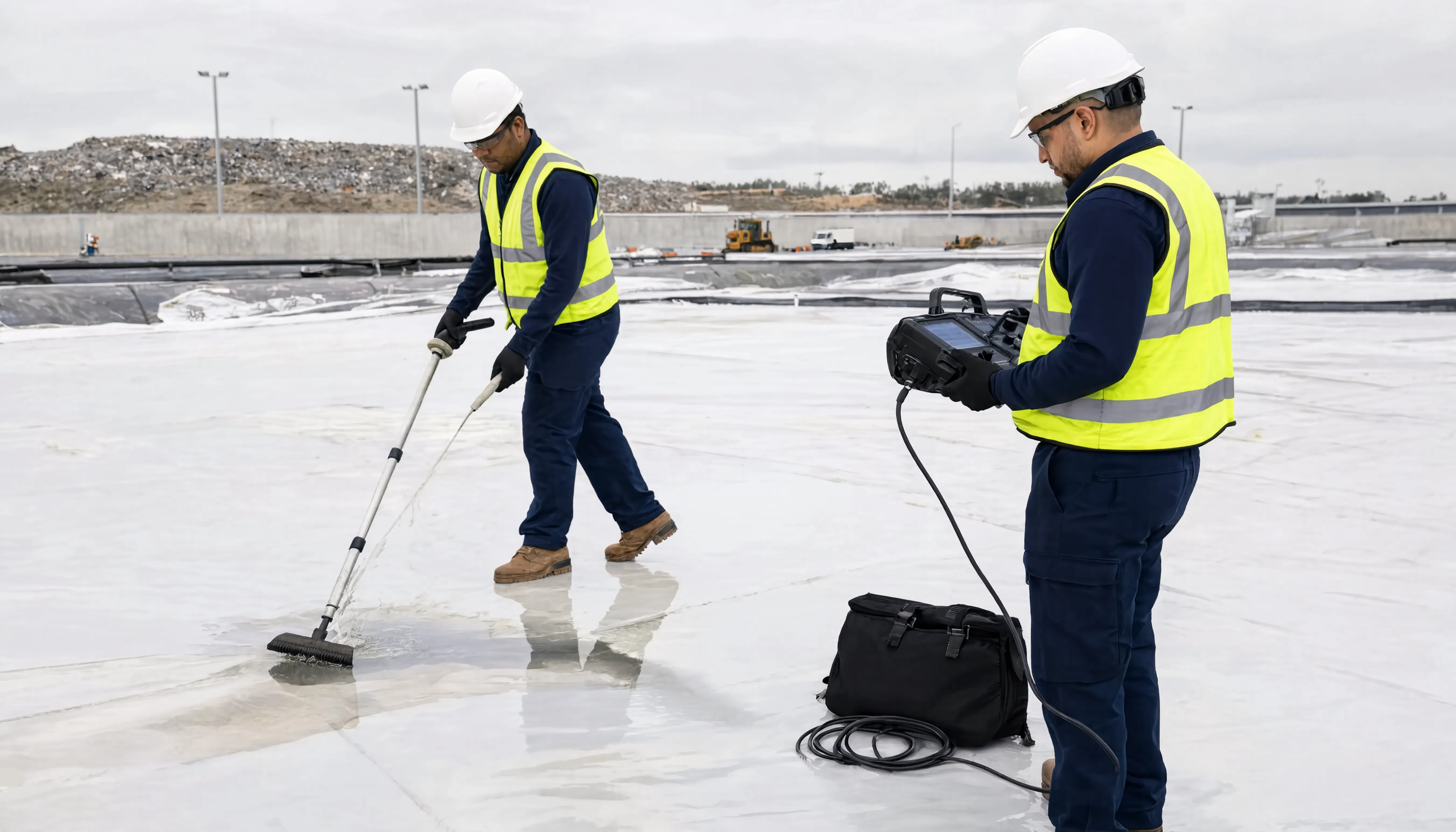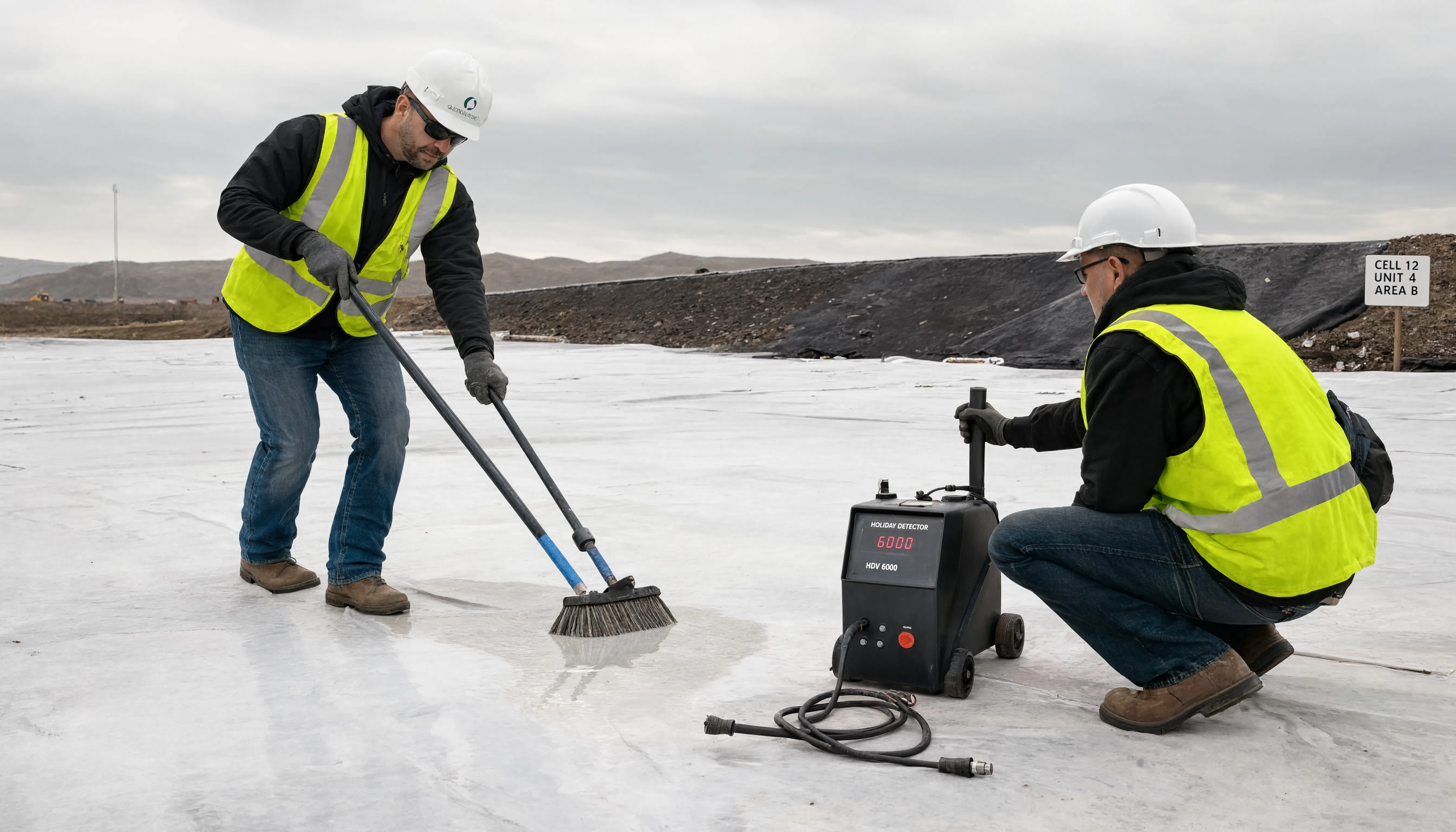
Arc testing for geomembrane liners is an electrical leak location method that finds holes in exposed geomembranes before cover material is placed. A technician sweeps a high-voltage probe across the dry liner surface, and wherever a hole lets the circuit reach the conductive layer beneath, an electrical arc forms and signals the defect. ASTM D7953 is the standard practice.
What Is Arc Testing for Geomembrane Liners?
Arc testing is one of several electrical leak location (ELL) methods for exposed, or bare, geomembranes. It works without water on the liner, which sets it apart from the water puddle and water lance methods used on the same exposed surfaces.
The governing standard is ASTM D7953, Standard Practice for Electrical Leak Location on Exposed Geomembranes Using the Arc Testing Method. It is a performance-based practice that applies to geomembranes in basins, ponds, tanks, ore and waste pads, landfill cells, landfill caps, canals, and other containment facilities. It covers polyethylene, polypropylene, PVC, chlorosulfonated polyethylene, bituminous geomembranes, and other sufficiently insulating materials.
ASTM D6747 is the companion guide for choosing among ELL techniques. It helps engineers decide when arc testing fits a project and when a water-based or covered-liner method is the better choice.
How Does Arc Testing Work?
Every ELL method relies on the same physics: the geomembrane is an electrical insulator, so current can only pass through it where there is a hole. Arc testing applies that principle without water on the surface.
- A high-voltage source is connected to the conductive material beneath the geomembrane, such as moist subgrade soil.
- A technician sweeps a probe, typically fitted with a conductive brush, across the exposed liner surface.
- Over sound geomembrane, the insulating sheet blocks the circuit and nothing happens.
- When the probe passes over a hole, current arcs through the opening to the conductive layer below, triggering an audible alarm at the defect.
- The technician marks the location for repair, and the repair is retested.
Before the survey, the crew confirms the equipment can detect a leak under actual site conditions by testing it on an artificial leak. That sensitivity check is what makes the results defensible, and it belongs in the survey report.
What equipment does an arc test use?
The basic kit is a high-voltage power source, a connection to the conductive layer beneath the liner, and a hand-held probe that the technician sweeps over the surface. Voltage is set for the geomembrane material and confirmed with the sensitivity test rather than chosen from a generic setting.
What Defects Does Arc Testing Detect?
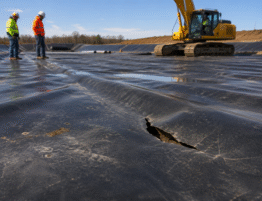
Arc testing locates any breach that lets the probe’s circuit reach the conductive layer beneath the geomembrane. ASTM D7953 defines a leak broadly to include holes, punctures, tears, knife cuts, seam defects, cracks, and similar breaches. In practice, that covers the damage most common on a newly installed liner:
- Punctures from stones in the subgrade or from equipment and tools
- Tears and cuts from deployment, foot traffic, and trimming
- Holes along seams and at patches, including voids at the edge of extrusion welds
- Defects at details such as pipe boots, penetrations, and sumps
- Holes too small to find reliably by visual inspection
Because the probe covers the full surface, arc testing checks the panel field as well as the seams. Holes in the sheet itself are found just as readily as defects along a weld.
When Should You Use Arc Testing?
Use arc testing on exposed geomembrane after installation and before any soil, drainage aggregate, or liquid goes on top of it. That is the window when holes are easiest to reach and cheapest to repair. It is especially well suited to:
- Side slopes and steep areas. Water-based methods need water to flow across or stand on the liner, which is hard to manage on slopes. Arc testing needs no water at all.
- Sites where water is scarce or unwanted. Arid locations and projects that cannot add water to the subgrade or liner benefit from a dry method.
- Details and tight areas. The hand-held probe reaches around penetrations, corners, and sumps.
- Landfill caps and cells, ponds, and pads. These are among the applications listed in the scope of ASTM D7953.
LLSI performs arc testing as part of our bare liner surveys on exposed geomembranes.
How Does Arc Testing Compare With Water-Based Methods?
Arc testing, the water puddle method, and the water lance method all survey exposed geomembranes. The main differences are whether water is needed and what surface conditions the survey requires.
| Factor | Arc testing | Water puddle / water lance |
|---|---|---|
| ASTM practice | D7953 | D7002 (puddle), D7703 (lance) |
| Water on the liner | None | Required to carry current to the hole |
| Liner surface | Must be dry | Wetted during the survey |
| Steep slopes | Well suited | Harder to keep water in contact with the liner |
| Conductive layer beneath liner | Required | Required |
Many projects use more than one method. An exposed-liner survey catches installation damage, and a survey after cover placement catches damage from spreading soil or aggregate. For a side-by-side look at LLSI’s survey options, see our comparison of geomembrane survey types.
What Are the Limitations of Arc Testing?
Arc testing is fast and water-free, but it depends on site conditions being right. These are the limits to plan around:
- Exposed liners only. Once soil, aggregate, or liquid covers the geomembrane, arc testing no longer applies. Covered liners need a covered-liner method such as our soil surveys or water surveys.
- A dry surface. Rain, dew, or condensation can conduct current across the surface and interfere with the signal, so surveys are scheduled around the weather.
- A conductive layer beneath. The material under the liner must conduct. Dry materials, including a geosynthetic clay liner that has not hydrated, may not, and areas where the liner bridges or lifts away from the subgrade can be harder to survey.
- Electrical isolation. Pipes, batten strips, and other conductive elements that cross the liner must be isolated so they do not short-circuit the survey.
- It does not test seam strength. Arc testing finds holes. Mechanical seam testing, such as air pressure testing of dual-track welds and vacuum box testing, evaluates weld quality separately. The two are complementary.
Planning for these conditions during construction, rather than on survey day, is the best way to get a complete, defensible result.
Frequently Asked Questions
Is arc testing the same as spark testing?
Not always. ASTM D7953 lists spark testing among its keywords, but the term is also used for a separate method on conductive-backed geomembranes under ASTM D7240. Because the names overlap, specifications should cite the ASTM practice by number, D7953 for arc testing of exposed geomembranes, so bidders know exactly which survey is required.
Does arc testing require water?
No. Arc testing works on a dry liner surface, which is why it suits steep slopes and sites where water is scarce. The water puddle (ASTM D7002) and water lance (ASTM D7703) methods, by contrast, use water to carry current to the hole. The material beneath the geomembrane still needs enough moisture to conduct.
Can arc testing be used on a covered geomembrane?
No. The probe has to pass directly over the bare liner surface. Once soil, aggregate, or liquid is placed, a covered-liner method is required, such as the dipole method under ASTM D7007. Many projects pair a bare liner survey with a covered survey to catch damage from cover placement.
What types of geomembrane can be arc tested?
ASTM D7953 applies to electrically insulating geomembranes, including polyethylene, polypropylene, PVC, chlorosulfonated polyethylene, and bituminous geomembranes. The liner must insulate well enough that current only passes through holes, and the material beneath it must conduct.
Does arc testing replace seam testing?
No. Arc testing locates holes, including defects along seams, but it does not measure weld strength or bond quality. Air pressure testing of dual-track seams and vacuum box testing remain part of construction quality assurance. Specifying both gives the owner a record of hole-free geomembrane and verified seams.
Schedule an Arc Test Before Cover Goes Down
The best time to find a hole in an exposed geomembrane is before anything is placed on top of it. Leak Location Services, Inc. is an international company specializing in electrical leak location surveys of geomembranes, with decades of field experience and ASTM-compliant methods. Review our qualifications and specification guidance, then contact us to scope a bare liner survey for your project.