Electrical leak location is a specialized testing method used to detect holes, defects, and imperfections in installed geomembrane liners. These liners are commonly used in landfills, ponds, reservoirs, mining facilities, wastewater containment systems, secondary containment areas, and other environmental protection applications. When a liner is installed, even small holes can allow liquids to escape or contaminants to migrate, which can create costly environmental, operational, and regulatory problems.
Electrical Leak Location, often called ELL, helps identify these problem areas after installation so they can be repaired before the containment system is placed into service or before a suspected leak becomes a larger issue. The process uses electrical principles to locate breaches in a geomembrane by identifying where current passes through a hole or defect in the liner.
For owners, engineers, contractors, and regulators, ELL provides a practical way to verify that a liner system has been tested for hidden damage. While visual inspection is important, it cannot always detect small punctures, covered holes, or imperfections caused during installation. ELL adds a higher level of testing by finding defects that may not be visible from the surface.
Understanding the Role of Geomembrane Liners
Geomembranes are synthetic liners used to create a barrier between contained materials and the surrounding environment. They are often made from materials such as HDPE, LLDPE, PVC, or other flexible polymers. Their main purpose is to help prevent liquids, chemicals, waste, or process fluids from escaping into soil or groundwater.
Geomembrane liners are used in many applications, including:
- Municipal solid waste landfills
- Hazardous waste containment areas
- Mining heap leach pads
- Tailings storage facilities
- Wastewater treatment ponds
- Stormwater ponds
- Agricultural lagoons
- Industrial containment systems
- Secondary containment around tanks
- Canals, reservoirs, and water storage facilities
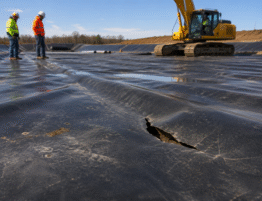
Even when liners are manufactured to strict standards and installed by skilled crews, damage can occur. Geomembranes may be punctured by stones, tools, equipment, welding activities, foot traffic, drainage materials, or construction debris. Some defects are obvious, while others are small enough to go unnoticed during visual inspection.
That is where Electrical Leak Location becomes valuable. It helps locate holes and imperfections that could compromise containment performance if left unrepaired.
What Is Electrical Leak Location?
Electrical Leak Location is a testing method that uses electrical current to locate holes in geomembrane liners. The basic concept is simple: geomembranes are generally nonconductive, while the materials above and below the liner can often conduct electricity when moisture is present.
If the liner has no holes, electrical current cannot easily pass through it. If there is a hole, current can travel through that opening and create a detectable signal. ELL equipment measures that signal and helps technicians identify the location of the defect.
In practical terms, ELL surveys are performed by trained field crews using specialized equipment designed for liner testing. The crew applies an electrical potential across the liner system and then scans the surface to detect areas where current is flowing through a defect.
Depending on the project, ELL may be performed on exposed geomembranes, covered geomembranes, or liners installed beneath soil, water, or other conductive materials. The correct method depends on site conditions, liner type, project specifications, and whether the liner is exposed or covered.
Why ELL Matters in Liner Testing
Geomembrane systems are often part of critical environmental protection infrastructure. A small hole may seem minor, but even a tiny defect can become a pathway for leakage. Over time, leakage can lead to contamination, regulatory violations, repairs, downtime, and financial losses.
ELL matters because it helps project teams find and repair defects before they become larger problems. It is especially useful because it can detect holes that may not be found through visual inspection alone.
Common reasons to use Electrical Leak Location include:
- Confirming liner quality after installation
- Finding punctures caused by construction activity
- Testing covered liners after placement of soil or drainage materials
- Locating suspected leaks in operating containment systems
- Supporting quality assurance and quality control programs
- Helping meet project specifications or regulatory requirements
- Reducing long-term environmental and operational risk
For many containment projects, ELL is not just an added service. It is a critical part of responsible liner testing.
How Electrical Leak Location Works
ELL works by creating an electrical circuit around the geomembrane liner. Since the liner is normally nonconductive, it acts as an electrical barrier. When there is a hole, the electrical current can pass through the defect and into the conductive material below or above the liner.
The testing team uses instruments to detect changes in electrical potential. These changes indicate that current is moving through a hole, defect, or imperfection. By following the signal, technicians can pinpoint the location of the problem.
A simplified ELL process may include the following steps:
- Site preparation: The testing area is reviewed to determine the best survey method. Conditions such as moisture, liner exposure, cover materials, and grounding are evaluated.
- Equipment setup: Electrical equipment is installed to create a controlled electrical field across the liner system.
- Survey execution: Technicians scan the liner surface or covered area using specialized probes, sensors, or survey equipment.
- Signal interpretation: The crew identifies voltage patterns that indicate current flow through holes or defects.
- Defect marking: Suspected defects are marked in the field for repair.
- Repair and retesting: The liner contractor repairs the marked areas, and follow-up testing may be performed to confirm that defects were addressed.
The exact process depends on the ELL method used and the physical conditions of the site.
Types of Electrical Leak Location Methods
There are several ELL methods used in geomembrane testing. The right method depends on whether the liner is exposed, covered, submerged, or installed in a specific containment configuration.
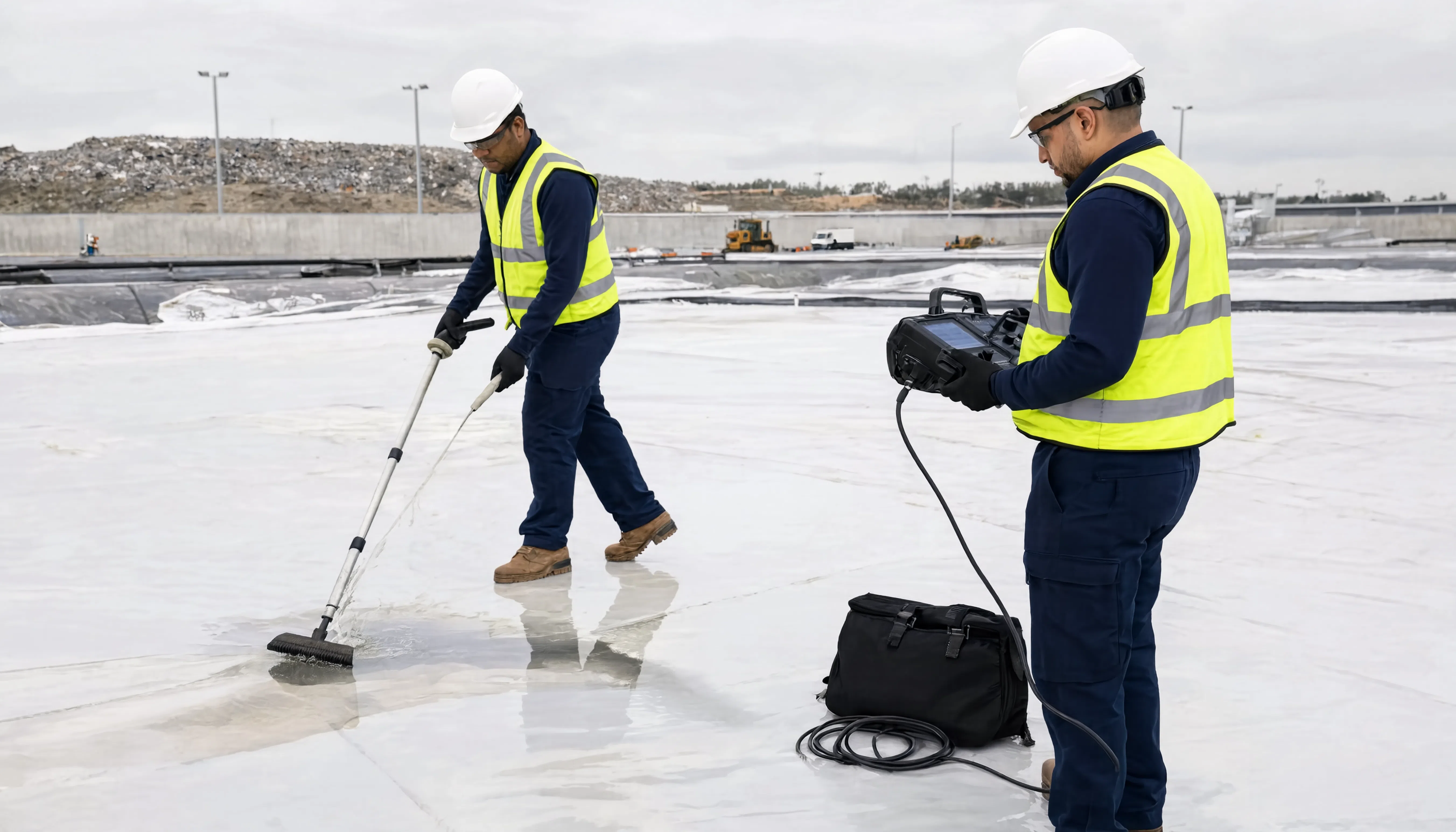
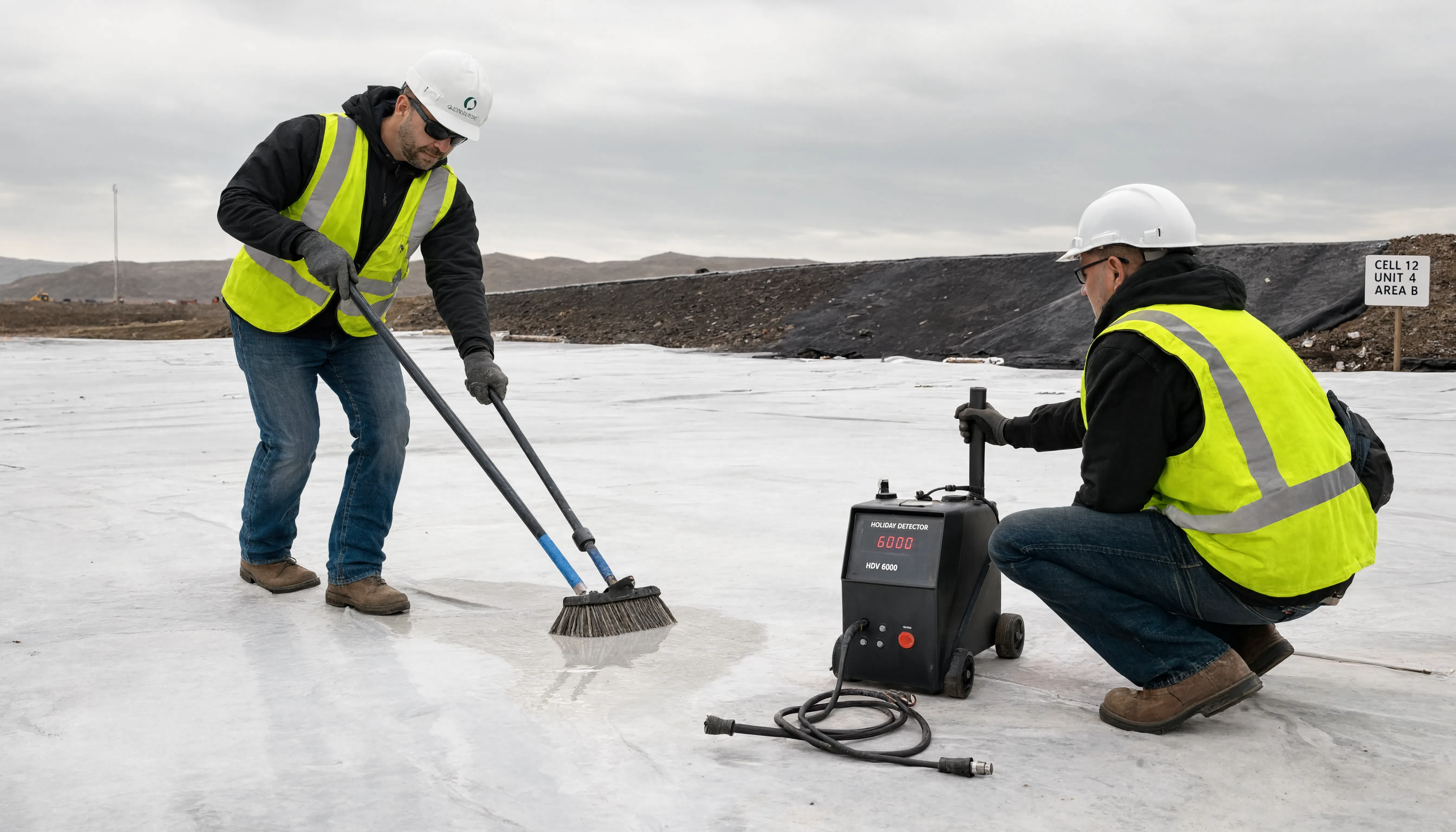
Water Puddle Method
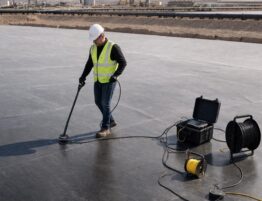
The water puddle method is commonly used on exposed geomembranes. A controlled amount of water is applied to the surface of the liner, and a technician uses a probe to scan the wetted area. If there is a hole, electrical current passes through the water and the defect, creating a detectable signal.
This method is often used for flat or gently sloped exposed liners. It can be effective for detecting small holes, provided that site conditions support the use of water and proper electrical contact.
Water Lance Method
The water lance method is another technique used on exposed geomembranes. Instead of spreading water over a wide area, the technician uses a stream of water from a wand or lance to create electrical contact with the liner surface. The water stream acts as part of the electrical circuit.
This method is useful for testing exposed liner surfaces and uses more water and covers less area per day than the water puddle method. This method is not widely used anymore.
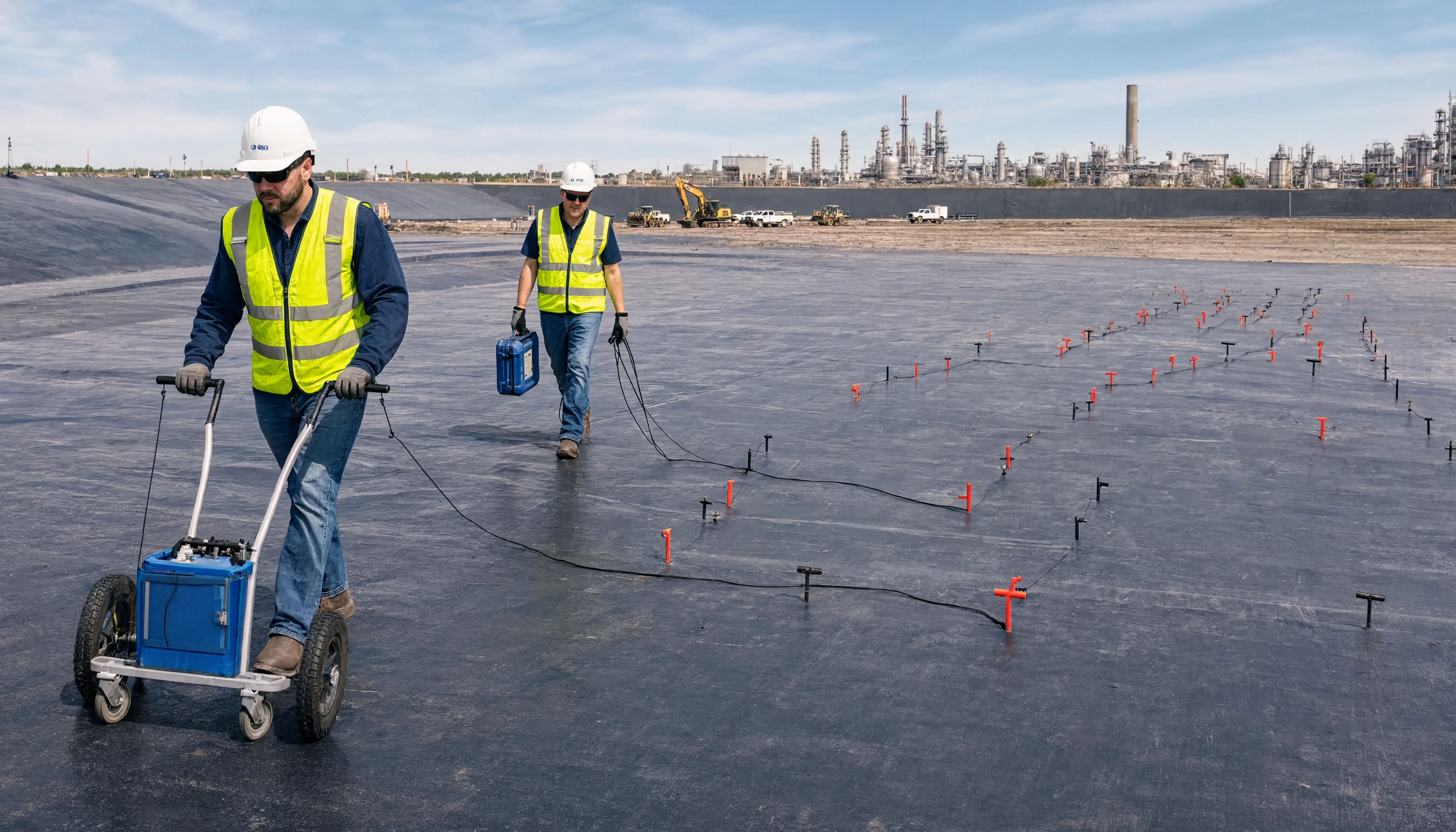
Dipole Method (Soil or Water Covered)
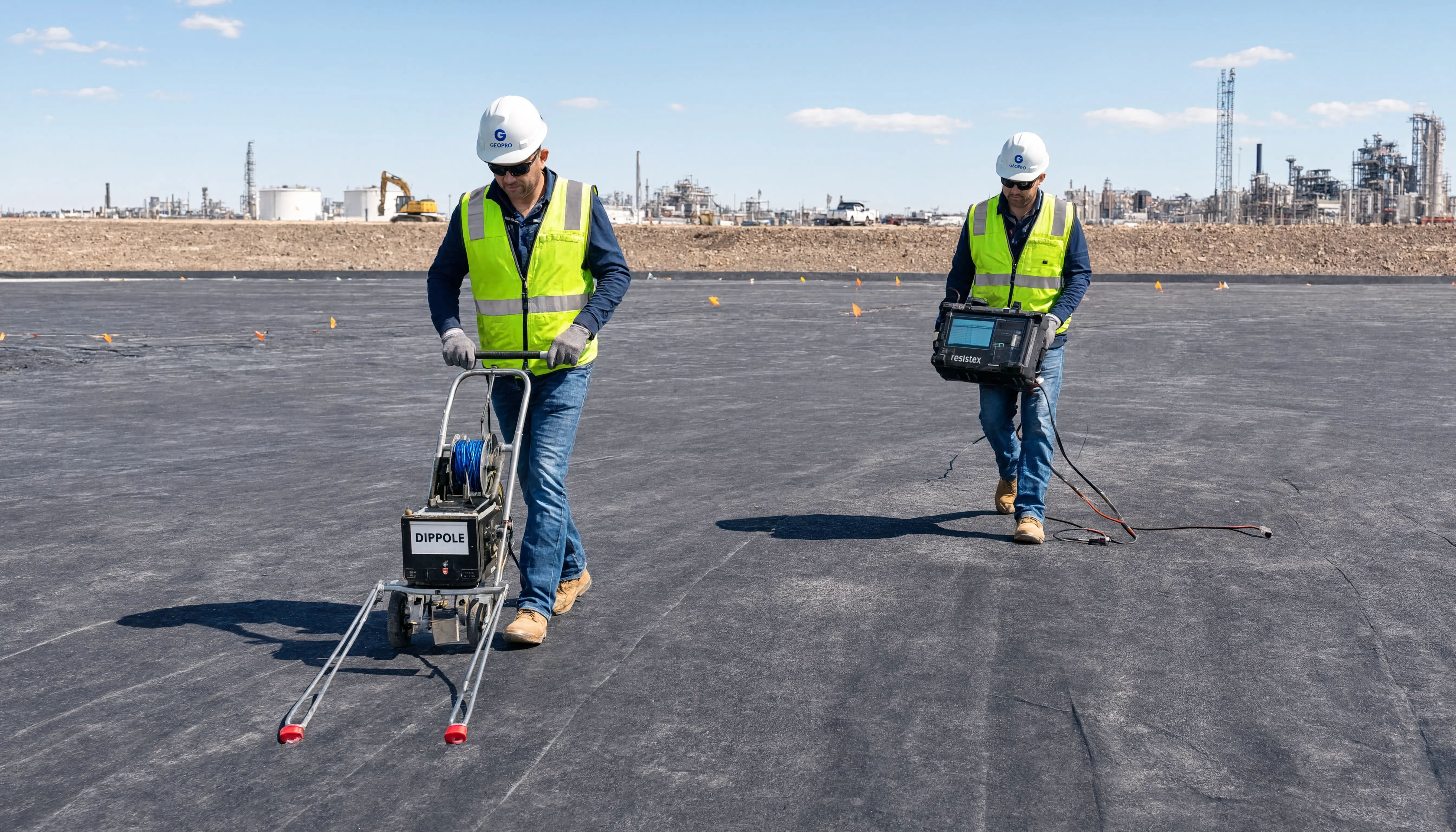
The dipole method is widely used for covered geomembranes. In this method, the liner is covered with conductive material such as soil, sand, gravel, or water. Technicians use a dipole probe to measure voltage differences on the surface of the cover material.
When the probe approaches a hole in the liner, the voltage pattern changes. By interpreting the signal, the technician can locate the defect beneath the cover material.
The dipole method is valuable because many liner defects occur after cover placement. Construction equipment, aggregate, drainage materials, and placement activities can puncture or damage a liner. Testing after cover placement helps identify defects caused during these activities.
Arc Testing
Arc testing, sometimes incorrectly called spark testing, is used in specific applications where the liner system allows for this type of testing. There must be a conductive media directly under the liner being tested. It involves applying a high-voltage electrical charge and detecting discharges that occur at holes.
Arc testing is not suitable for every geomembrane or site condition, so it must be selected carefully by qualified professionals. When used properly, it can help locate defects in exposed liner systems or certain nonconductive barrier applications.
Spark Testing
Spark testing is used in specific applications where the liner system allows for this type of testing. The liner itself must have a conductive underside. It involves applying a high-voltage electrical charge and detecting discharges that occur at holes.
Spark testing is not suitable for every geomembrane or site condition, so it must be selected carefully by qualified professionals. When used properly, it can help locate defects in exposed liner systems.
What Types of Defects Can ELL Find?
Electrical Leak Location is designed to find holes and pathways through the geomembrane. It is especially useful for identifying defects that are too small or hidden for visual detection.
ELL can help locate:
- Punctures from rocks, tools, or equipment
- Holes caused during construction
- Damage from cover soil or drainage aggregate placement
- Tears and cuts in the liner
- Burn-throughs or other welding-related defects
- Imperfections at seams or penetrations
- Damage around pipe boots, sumps, and structures
- Small defects beneath cover materials
ELL is not a replacement for proper installation, seam testing, or visual inspection. Instead, it complements those practices by adding another layer of detection. A complete liner quality program may include visual observation, seam testing, destructive and nondestructive weld testing, documentation review, and Electrical Leak Location.
Exposed vs. Covered Liner Testing
One of the most important distinctions in ELL is whether the geomembrane is exposed or covered.
Exposed Liner Testing
Exposed liner testing is performed before cover material is placed. The geomembrane is visible and accessible, making it easier to mark and repair defects. Methods such as water puddle, water lance, or spark testing may be used depending on the liner and site conditions.
Advantages of exposed liner testing include:
- Easier access to the liner surface
- Faster repair of located defects
- Direct visual confirmation of marked areas
- Useful before the next phase of construction begins
However, exposed liner testing cannot identify damage that may occur later during cover placement. For that reason, some projects use both exposed and covered testing.
Covered Liner Testing
Covered liner testing is performed after soil, gravel, drainage material, or water has been placed over the geomembrane. This is often done because cover placement is one of the most common times for liner damage to occur.
The dipole method is frequently used for covered liner surveys. It allows technicians to detect defects beneath the cover material without removing the entire cover layer.
Advantages of covered liner testing include:
- Detection of damage caused during cover placement
- Ability to test liners after construction activities
- Useful for large containment areas
- Valuable for landfills, mining facilities, ponds, and reservoirs
Covered liner testing may require proper moisture conditions and conductive cover materials. Site preparation is important to produce reliable survey results.
Factors That Affect ELL Survey Results
The success of an ELL survey depends on site conditions, equipment setup, technician experience, and the selected testing method. Because ELL is based on electrical conductivity, the surrounding materials must support the formation of an electrical circuit.
Key factors include:
- Moisture: Water helps conduct electricity. Dry soil or dry cover materials may need moisture conditioning.
- Liner material: Most geomembranes are nonconductive, but project-specific liner materials should be evaluated.
- Subgrade conditions: The material beneath the liner must allow current flow for certain methods.
- Cover material: Soil, sand, gravel, and water can affect signal strength.
- Defect size: Larger holes may create stronger signals, while very small defects require careful survey technique.
- Site geometry: Slopes, wrinkles, sumps, penetrations, and corners can influence testing conditions.
- Electrical isolation: The liner system must be properly isolated so the survey can detect signals associated with defects.
- Technician experience: Proper setup and interpretation are critical to locating defects accurately.
Because of these variables, ELL should be performed by experienced specialists who understand both geomembrane systems and electrical testing methods.
When Should ELL Be Performed?
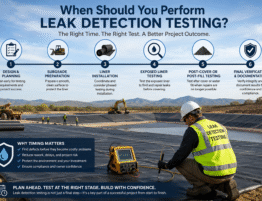
Electrical Leak Location may be used at several stages of a project. The best timing depends on project goals and specifications.
Common times to perform ELL include:
- After liner installation and before cover placement
- After protective soil or drainage aggregate is placed
- Before a containment system is commissioned
- During construction quality assurance programs
- During investigation of a suspected leak
- As part of periodic maintenance or compliance testing
- After repairs, upgrades, or construction modifications
For new installations, ELL is often most effective when planned early. This allows the project team to design the liner system, subgrade, cover materials, and moisture conditioning with testing in mind.
Benefits of Electrical Leak Location
ELL provides meaningful benefits for owners, engineers, contractors, and regulators. It helps reduce uncertainty by identifying defects that could otherwise remain hidden.
Key benefits include:
- Improved defect detection: ELL can find holes that are difficult or impossible to see.
- Better construction quality control: Testing helps verify that construction activities have not damaged the liner.
- Reduced environmental risk: Finding and repairing holes helps reduce the chance of leakage.
- Cost savings: Early detection can prevent expensive repairs, downtime, and remediation.
- Project documentation: Survey reports provide useful records for owners, engineers, and regulators.
- Support for compliance: ELL can help satisfy project specifications and regulatory expectations.
- Confidence before operation: Owners can place systems into service with more information about liner condition.
Limitations of Electrical Leak Location
Although ELL is a powerful testing method, it is important to understand its limitations. It is not magic, and it must be performed under suitable conditions.
Limitations may include:
- Some methods require moisture to create conductivity.
- Dry cover materials can reduce signal strength.
- Conductive objects, wrinkles, penetrations, or site features may affect readings.
- Testing may be limited if the liner is not electrically isolated.
- Certain liner configurations may require special planning.
- Survey results depend heavily on technician expertise and proper setup.
These limitations do not reduce the value of ELL. They simply mean that the survey must be planned and performed correctly.
Why Experience Matters in ELL
Electrical Leak Location requires more than equipment. It requires field judgment, technical knowledge, and experience with different liner systems and site conditions.
Experienced ELL professionals understand how to:
- Select the correct method for the project
- Evaluate site conditions before testing
- Set up electrical circuits properly
- Recognize valid defect signals
- Distinguish defects from interference
- Communicate findings clearly to the project team
- Support repairs and retesting when needed
Because every site is different, experience is especially important on complex projects, large facilities, international assignments, and operating containment systems.
FAQ
What is Electrical Leak Location?
Electrical Leak Location is a liner testing method that uses electrical current to locate holes, defects, and imperfections in geomembranes. It identifies areas where current passes through a breach in the liner.
What does ELL detect?
ELL detects holes or openings that allow electrical current to pass through the geomembrane. These may include punctures, tears, cuts, seam-related defects, and construction damage.
Is ELL only used on new liners?
No. ELL can be used on new installations, existing containment systems, suspected leak investigations, and post-repair testing.
Can ELL test covered liners?
Yes. Certain ELL methods, such as the dipole method, can test geomembranes covered with conductive materials like soil, gravel, or water.
Can ELL replace visual inspection?
No. ELL should be used along with visual inspection, seam testing, and other quality control practices. Each method has a different purpose.
How small of a hole can ELL find?
Detection depends on the method, site conditions, moisture, liner configuration, and technician expertise. Under proper conditions, ELL can locate very small holes that may not be visible.
Does ELL require water?
Some methods require water or moisture to create electrical conductivity. Other methods may have different requirements. The project conditions determine the best approach.
Who should perform ELL surveys?
ELL surveys should be performed by trained specialists with experience in geomembrane systems, electrical testing methods, and field signal interpretation.
Is ELL useful after repairs?
Yes. ELL can be used after repairs to help confirm that marked defects have been addressed and that no additional holes are detected in the surveyed area.
What industries use Electrical Leak Location?
ELL is used in waste management, mining, water storage, wastewater treatment, agriculture, energy, industrial containment, and environmental protection projects.
Partner With Leak Location Services, Inc.
Electrical Leak Location is one of the most effective ways to locate holes, defects, and imperfections in geomembrane liner systems. When performed by experienced professionals, it gives owners, engineers, and contractors valuable information before a system is placed into service or when a suspected leak needs to be investigated.
We are an international company specializing in Electrical Leak Location Surveys of Geomembranes. With over 33 years of experience, we deliver first-class surveys for clients worldwide. From new construction testing to complex leak investigations, our team brings the technical knowledge, field experience, and professional service needed to support successful containment projects.
To learn more or discuss your next geomembrane survey, contact us today.