Landfill liner testing requirements play a critical role in protecting groundwater, soil, and surrounding ecosystems from contamination. Across the United States, regulatory agencies require landfill owners and operators to verify the integrity of geomembrane liners before waste placement and throughout a facility’s operational life.
While federal regulations establish baseline standards, individual states often impose additional or more stringent requirements. Understanding these variations is essential for maintaining compliance, avoiding costly violations, and ensuring long-term environmental protection.
Why Landfill Liner Testing Is Essential
Landfill liners serve as the primary barrier preventing leachate from migrating into the environment. Even minor defects such as pinholes, seam flaws, or installation damage can lead to significant environmental and regulatory consequences if left undetected.
Key objectives of landfill liner testing include:
- Verifying the proper installation of geomembranes before waste placement
- Detecting defects that are not visible through visual inspection alone
- Demonstrating regulatory compliance to state and federal agencies
- Reducing long-term liability and remediation costs
- Supporting environmental stewardship and public trust
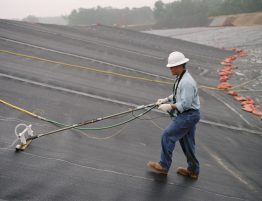
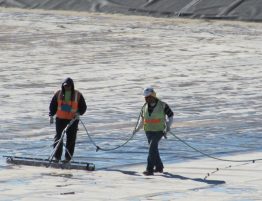
Leak Location Surveys have become the industry standard for identifying liner defects accurately and efficiently, particularly for large and complex containment systems.
Federal Framework Governing Landfill Liners
At the federal level, landfill liner requirements are primarily governed by:
- Resource Conservation and Recovery Act Subtitle D for municipal solid waste landfills
- Resource Conservation and Recovery Act Subtitle C for hazardous waste facilities
These regulations establish minimum design and performance criteria, including composite liner systems, leachate collection, and quality assurance protocols.
Federal guidance generally requires:
- Installation of composite liners consisting of geomembranes and compacted clay or geosynthetic clay liners
- Construction Quality Assurance programs to verify proper installation
- Documentation demonstrating liner performance
While federal rules do not always explicitly mandate leak location testing, many states incorporate these methods into their permitting and quality assurance requirements.
State-by-State Variations in Compliance Requirements
Each state environmental agency has the authority to enforce landfill liner testing requirements that may exceed federal minimums. The sections below summarize common regional approaches. Operators should always consult state-specific regulations and permit conditions.
California
California maintains some of the most stringent landfill liner testing requirements in the nation. Regulatory oversight is provided by CalRecycle and regional water quality control boards.
Common requirements include:
- Mandatory electrical leak location testing on primary and secondary liners
- Testing before waste placement and after repairs
- Detailed reporting and documentation submission
Electrical methods are widely recognized in California as best practice for verifying liner installations.
Texas
The Texas Commission on Environmental Quality oversees landfill permitting and compliance.
Typical requirements include:
- Construction Quality Assurance plans that may require electrical liner surveys
- Leak detection verification for composite liner systems
- Documentation of corrective actions for identified defects
While not always explicitly mandated statewide, electrical testing is frequently required through permit conditions.
Florida
Florida landfill regulations emphasize groundwater protection due to sensitive hydrogeologic conditions.
Key compliance elements often include:
- Liner integrity verification during construction
- Electrical leak location testing for geomembranes in contact with conductive subgrade
- Post-repair verification testing
State regulators increasingly expect electrical surveys as part of best available technology.
New York
The New York State Department of Environmental Conservation enforces robust liner testing standards.
Common practices include:
- Mandatory geomembrane testing for new construction and expansions
- Mandatory electrical leak location testing on primary and secondary liners
- Electrical leak detection methods accepted as standard practice
- Comprehensive recordkeeping for regulatory review
Testing is often required before system certification.
Midwest States
States such as Illinois, Ohio, and Michigan generally align closely with federal Subtitle D requirements but may impose additional quality assurance measures.
Typical expectations include:
- Construction Quality Assurance programs referencing electrical liner testing
- Testing of geomembrane seams and penetrations
- Regulatory approval before waste placement
Electrical surveys are commonly used to satisfy liner integrity verification.
Western States
States including Arizona, Nevada, and Colorado recognize leak location surveys as an effective compliance tool.
Common requirements include:
- Liner testing for municipal and industrial landfills
- Verification of secondary containment systems
- Reporting of defect locations and repairs
Dry climate conditions make electrical testing particularly valuable for detecting subtle installation damage.
Southeastern States
Georgia, North Carolina, and South Carolina often require liner testing through permit-specific conditions.
Typical elements include:
- Electrical surveys for composite liner systems
- Testing following liner repairs or modifications
- Submission of survey results to state agencies
Regulators increasingly view electrical testing as a proactive compliance measure.
Summary Chart: State-Level Liner Testing Expectations
| Region | Regulatory Emphasis | Common Testing Expectations |
|---|---|---|
| California | Stringent oversight | Mandatory electrical testing on primary and secondary liners |
| Texas | Permit-driven compliance | Electrical surveys required through CQA and permits |
| Florida | Groundwater protection | Electrical testing for conductive subgrades |
| New York | Formal certification | Mandatory electrical testing and recordkeeping |
| Midwest | Federal alignment plus QA | Electrical surveys referenced in CQA programs |
| Western States | Damage prevention | Electrical testing for subtle installation defects |
| Southeastern States | Permit-specific controls | Electrical testing following repairs or modifications |
Accepted Liner Testing Methods
While states vary in their regulatory language, several liner testing methods are widely accepted across jurisdictions. Leak Location Surveys are among the most reliable and comprehensive options.
Common methods include:
- Water puddle method for exposed liners
- Arc testing for dry conditions
- Dipole methods for covered liners
- Spark testing for newly installed conductive liners and double-lined slopes
Electrical methods are capable of detecting defects as small as a few millimeters, providing a level of assurance that visual inspections cannot match.
Documentation and Reporting Expectations
Proper documentation is a critical component of landfill liner compliance. Most state agencies require detailed records demonstrating that liner testing was performed in accordance with approved plans.
Documentation typically includes:
- Description of testing methodology used
- Survey coverage area and testing conditions
- Identified defect locations and repair actions
- Post-repair verification results
- Certification by qualified professionals
Accurate reporting not only satisfies regulatory requirements but also supports long-term facility management and risk reduction.
Consequences of Non-Compliance
Failure to meet landfill liner testing requirements can result in significant consequences, including:
- Permit delays or revocation
- Fines and enforcement actions
- Mandatory corrective measures
- Increased environmental liability
- Damage to organizational reputation
Proactive liner testing reduces these risks by identifying and resolving issues early in the construction or operational process.
The Value of Specialized Expertise
Given the complexity and variability of state requirements, working with an experienced liner testing provider is essential. Specialized firms understand regulatory expectations, testing technologies, and documentation standards across multiple jurisdictions. This expertise ensures surveys are performed efficiently, accurately, and in full compliance with applicable regulations.
Partner With Leak Location Services, Inc.
Navigating landfill liner testing requirements across different states demands precision, experience, and proven technology. Leak Location Services, Inc. is an international leader in Electrical Leak Location Surveys of geomembranes, with over 33 years of experience delivering first-class surveys for clients worldwide.
Our team works closely with landfill owners, engineers, and regulators to ensure liner systems meet or exceed compliance standards while minimizing risk and cost. To learn how Leak Location Services, Inc. can support your landfill project with reliable, regulator-accepted liner testing solutions, contact our experts today.